
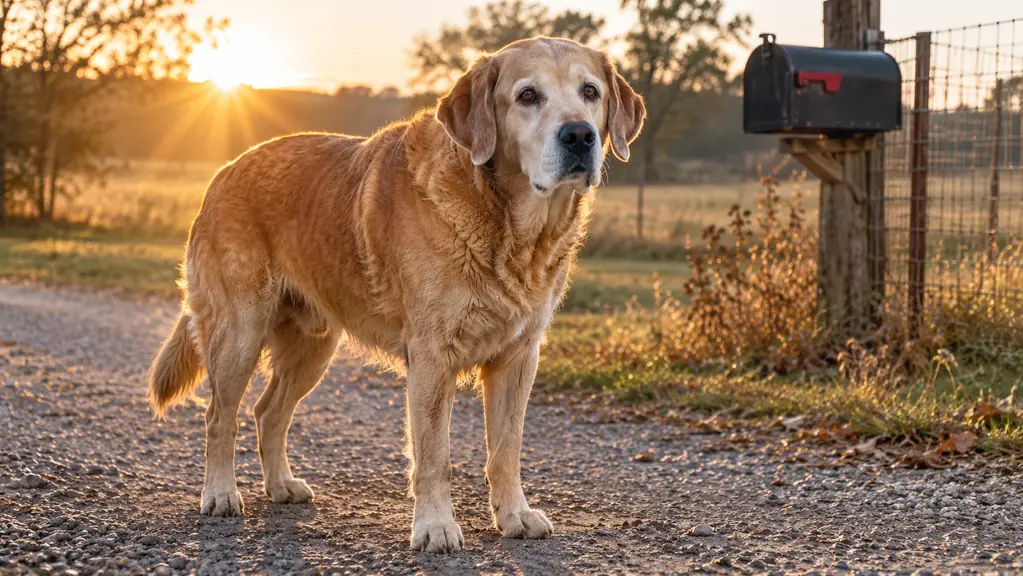
The bottle of Natural Dog Company Wild Alaskan Salmon Oil sat behind the flour canister for eleven days before I opened it. I had talked myself out of it twice. Tansy was eleven that spring, a German Shorthaired Pointer who still believed every gravel truck on our road needed investigating, and she had started taking a long time to get up off the kitchen floor. I am not a veterinarian. I carried mail on one rural route outside Bend for twenty-nine years, and what I know about dogs I know from watching them move. It is a narrow kind of knowing. It is also enough to notice when something has changed.
What changed was her back end. She stood up in stages: front legs, a pause, then the back. She began eyeing the two porch steps like they had grown overnight. Our vet did a senior checkup, said her hips and knees are showing age, and went through the things I already half knew about weight, traction, and short daily walks. She also said a fish oil was reasonable to try. The omega-3s are worth having in an older dog's diet, she said, and I should not expect anything dramatic. I have thought about that last sentence more than any other part of the visit.
This is an honest review, so let me say up front what it is not. It is not a turnaround story. It is four months of daily use, the parts that took weeks to show up, and the parts of a liquid supplement that nobody mentions when they are typing a five star review at ten at night. If your dog is stiff and you want to know whether a salmon oil is worth the counter space, that is the question I am trying to answer.
The Quick Verdict
A 16 ounce liquid salmon oil with EPA and DHA named on the label that I could get into Tansy's bowl every single day, which is more than I managed with capsules. It took about six weeks to see anything and it has not fixed her hips.
Amazon Check Today's Price →The pump bottle that got omega-3s into a dog who eats around pills
Wild Alaskan Salmon Oil, 16 fluid ounces, pump included in the box. One press over the evening kibble. Four months in and the bottle is still in the same spot by the bowls.
Amazon Check Today's Price on Amazon →How I've Used It
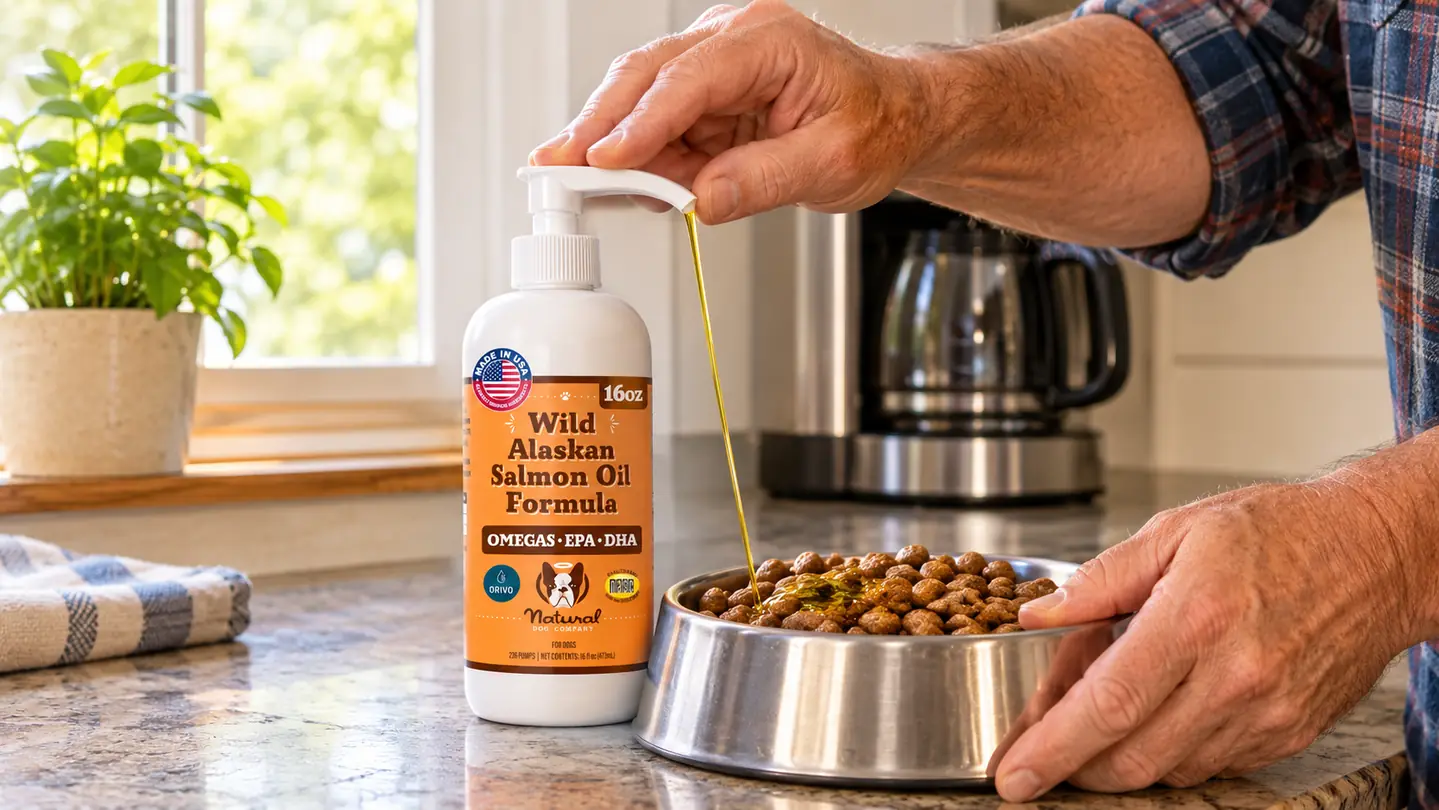
One pump over her evening kibble. That is the entire routine, and the routine is the reason this bottle stayed on my counter when two earlier attempts did not. The pump comes in the box with the bottle. Before this I was splitting capsules and hiding them in a spoon of peanut butter, and Tansy is a dog who eats around things. I would find a gel cap licked clean and left on the mat like a small abandoned boat. Oil goes into the food and vanishes into the food.
I keep the bottle standing by the bowls, which in my kitchen means the narrow gap between the coffee maker and the wall. It measures about two and a half inches across and eight inches tall, so it fits there without being knocked onto the floor every time I reach for the coffee. Sixteen fluid ounces has lasted well past the point I expected, because one press is a small amount and I am not generous with it.
I asked our vet to check the amount for a 58 pound dog rather than guessing from the back of the bottle, because the print is small and I am 63. She gave me a number and I have stuck to it. That is the dullest paragraph in this review and probably the most useful one.
What the Label Actually Says
The Natural Dog Company bottle lists EPA, DHA, omega-3 and omega-6 as the active ingredients. The oil itself is salmon and pollock, wild Alaskan per the name on the front, and it comes as a liquid rather than a chew or a capsule. It is labeled for small, medium, and large dogs, which covers most of us. The listed benefits run longer than the ones I bought it for: joint health, skin and coat, heart, immune support, digestive health, and antioxidant support.
Here is where I stop being impressed by a label and start reading it. A long list of benefits is not the same as knowing what your dog is getting per serving. Two fish oils can both say omega-3 on the front and be nowhere near each other underneath, because omega-3 is a category and EPA and DHA are the parts of it that people are usually counting. I am not a chemist and I will not pretend to be one. What I did was set this bottle next to the two capsule products I had tried and ask our vet which of the three she would pick for a dog Tansy's age and weight. She picked a liquid. Her reason was not that liquid is stronger. Her reason was that I would actually use it.
I also spent one Saturday morning at the kitchen table with three labels and a magnifying glass, writing the numbers on the back of an envelope. The two capsule bottles listed their fish oil in milligrams per capsule and did not split out EPA and DHA in a way I could hold up against a liquid measured by the pump. That envelope is still in the drawer. It did not settle anything, but it did teach me to stop comparing the front of one bottle to the front of another and calling it research.
The listing calls it a food topper and that is exactly how it behaves. You are adding fat and calories to the bowl. For a dog with aging hips, every extra pound is a pound those hips are carrying, and our vet has said that to me more than once. I trimmed her kibble slightly when I started and her weight at the next checkup was where it had been. If your dog is already carrying extra weight, that is a conversation to have before you start pouring oil on the food, not after.
Capsules First, Then This Bottle
I want to be fair to the capsules, because plenty of dogs take them without complaint and they are the simpler thing to buy. Mine did not. The first product was a soft gel I was supposed to give whole, and Tansy treated it as a foreign object to be moved around the bowl and eventually deposited on the floor. The second was a chew, which she ate happily for nine days and then decided she no longer recognized. Nine days of a supplement does nothing. I know that. I also know that I am the one who stopped.
The chew went out in a trash bag that also held three quarters of a bag of kibble she had gone off that same week, which tells you how that month went. I remember the date because it was the week the farrier came out, and I stood in the driveway talking about my dog's back end to a man who works on horses and has forgotten more about lameness than I will ever know. He said keep her moving. I have.
A liquid has its own set of problems, which I will get to. What it does not have is a texture a dog can reject. It goes on the food, it smells like fish, and a dog who likes fish eats the food. Tansy cleans the bowl. There is no negotiating at seven in the evening, and at my age the not negotiating is worth something.
What Took Six Weeks to Notice
Nothing happened for a month. I want to be plain about that, because reviews that describe a dog trotting up stairs in three days made me suspicious of my own eyes. Weeks one through four, Tansy was the same stiff dog she had been since winter.
The first thing I noticed was not her hips. It was her coat. She had been scurfy along her back all winter, the kind of dry flakiness that shows up on a dark rug and makes you feel like a poor owner. Sometime in the third or fourth week that eased. Her coat felt different under my hand, less dry, and the brush came away with less in it. I was not watching for that. It is also the change I am most confident about, because fur is easier to judge than a dog's opinion of her own hips.
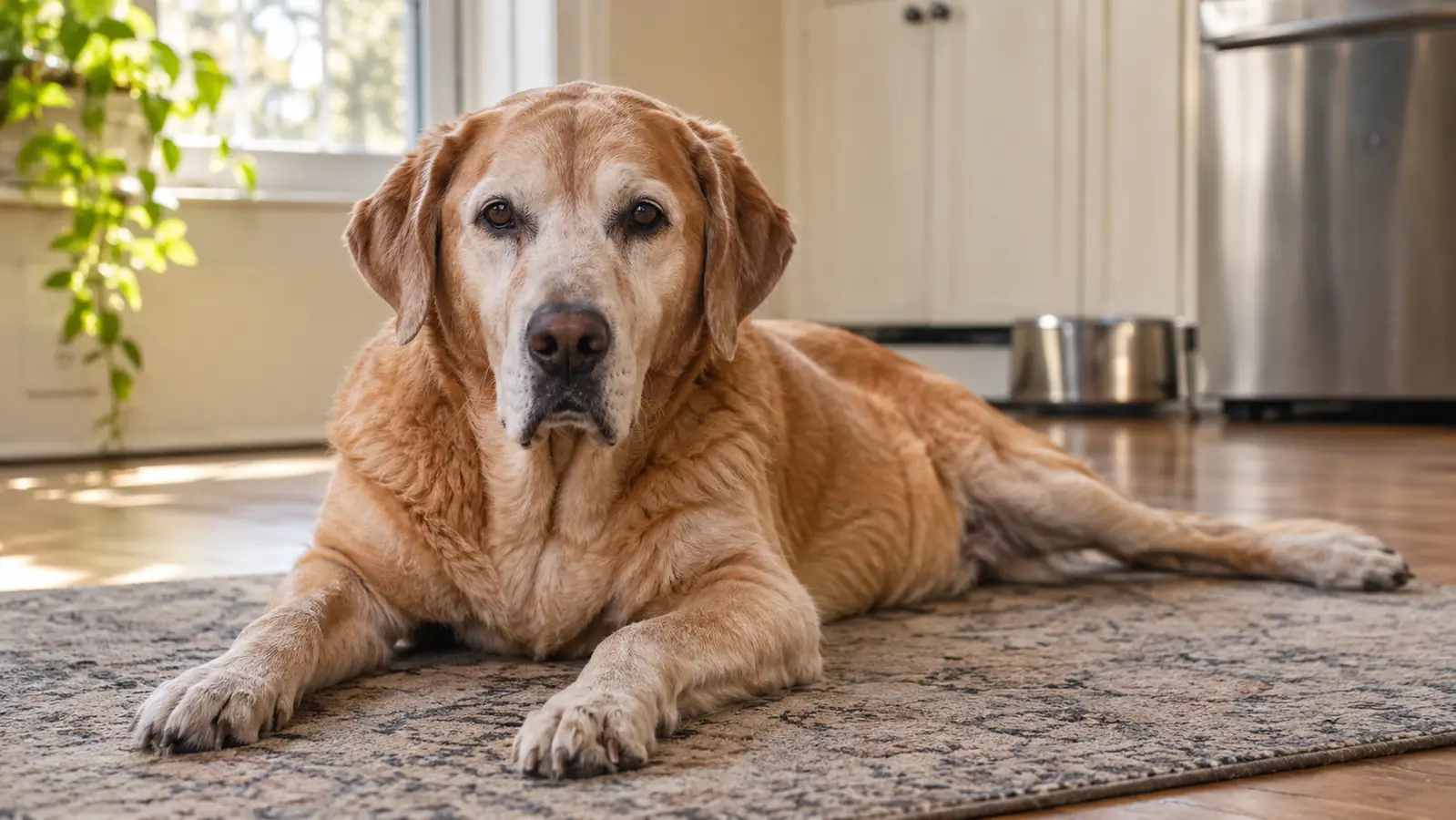
Around the fifth and sixth week I started noticing the standing up. Not that she was fast. That the pause in the middle, the hitch between the front legs going up and the back legs following, had gotten shorter. She would still push up front first. The wait before the back end came was just less. That is a small thing to write down and it was not a small thing to watch.
Not that she got up fast. The pause in the middle between the front legs and the back got shorter.
What Nobody Tells You About a Liquid Oil
It is messy in a way that never quite stops. The pump drips a little down the side of the bottle no matter how careful I am, and after a few weeks the outside of the bottle is slick unless I wipe it. I keep a rag under it now. The bowl needs a stir or the oil pools at one end and the last bites of kibble are swimming. None of that is a reason to skip it. It is a reason to know what you are getting into before the bottle arrives and you are surprised by a grease ring on the counter.
There is also the arithmetic of a sixteen fluid ounce bottle. I worked it out early, that one press a day would carry me through months rather than weeks, and that arithmetic is the reason I was willing to leave the bottle on the counter through the stretch where nothing was happening. If I had been buying a small bottle every few weeks I would have quit in the fourth week out of pure irritation and told you it did nothing.
The smell is real. It is salmon oil, it smells like salmon oil, and my kitchen smells faintly of it for a few minutes after I feed her. Tansy finds this extremely interesting and stands directly behind me while I pump, which is its own hazard. I keep the cap on and the bottle in a cool cupboard and I wipe the spout. Whether your particular bottle wants the refrigerator is a question for the printing on your bottle, not for me.
The other thing nobody mentions: this is fat, and some dogs handle a sudden increase in fat less gracefully than others. I started with less than the bottle suggested and built up over a couple of weeks. If your dog has ever had a touchy stomach or a pancreatitis scare, that is a conversation for your vet before the first pump, not after. I am careful about this because I have cleaned up after a dog who got into something rich, and I would rather not repeat it at my age.
What It Did Not Do
It did not make the porch steps disappear. Tansy still takes the two steps down one at a time, and she still thinks about it at the top. She is better at it, meaning she no longer stands there long enough for me to come out and check on her, but the caution is still there and I expect it will stay. A supplement supports a joint. It does not rebuild one, and anyone who tells you otherwise is selling something.
It did not fix the floor. Her back feet still slide on the laminate when she turns too fast toward the door, and no oil in the world changes that. That one is a rug problem. The runner I bought was six feet long and I laid it from the doorway to the middle of the kitchen, which is the stretch she crosses at a trot when she hears the Subaru come up the drive. Her back feet catch on it now instead of going out from under her. That is a piece of rubber doing the work, not the oil, and I would rather say so than let a bottle take credit for it.
It did not make her want to walk farther either. She still fades at about the same corner on our road, and she still lifts a paw at the step into the back of the Subaru before committing to it. What changed is that she gets up to go in the first place, which is a different thing and the one I cared about.
And it did not replace our vet. I want to be plain about that too. The senior checkup is what told me her hips and knees are showing age. The oil is something I do between checkups, alongside keeping her weight down, keeping her moving, and keeping the floor from being a skating rink. If your dog has not had a senior checkup, that comes before any bottle.
What I Liked
- The pump is in the box, so there is nothing extra to buy
- A liquid topper is much harder for a picky dog to eat around than a capsule or a chew
- EPA and DHA are named on the label as the active ingredients
- One 16 fluid ounce bottle has lasted months at a single press a day
- The most visible change for us was her coat, which came before any change in how she moved
Where It Falls Short
- It took about six weeks before I noticed anything in how she stood up
- The pump drips and the outside of the bottle needs wiping
- It is added fat and calories, which matters for a dog carrying extra weight
- The kitchen smells of fish for a few minutes after every meal
- It supports her comfort, it does not fix her hips or her footing on a slick floor
Who This Is For
This is for the owner of an older dog who has already seen the vet and heard that the hips or knees are showing age, and who wants something simple to add to the bowl while they do the other things, the weight and the walking and the traction. It is for someone who tried a capsule and watched it end up on the floor. It is for a dog who likes fish and cleans the bowl without being asked twice. And it is for someone patient enough to give it six weeks before deciding, because a month in I would have told you it did nothing.
Who Should Skip It
Skip it if your dog has not been seen about the stiffness, because oil is not a diagnosis and the thing slowing your dog down may not be a joint at all. Skip it if your dog is overweight and you are not willing to trim the kibble to make room, since pouring oil onto an unchanged bowl is adding weight to hips that are already complaining. Skip it if your dog has a history of pancreatitis or a sensitive gut and you have not asked about fat. And skip it if you want a fast answer. This is a slow, dull, daily thing, and the dogs who benefit from it are the ones whose owners keep pumping when nothing seems to be happening.
Four months in, the bottle is still by the bowls
Natural Dog Company Wild Alaskan Salmon Oil for dogs, 16 fluid ounces with a pump in the box. If your vet has already said the hips are showing age, this is one of the simpler things you can add to the evening meal.
Amazon Check Today's Price on Amazon →