
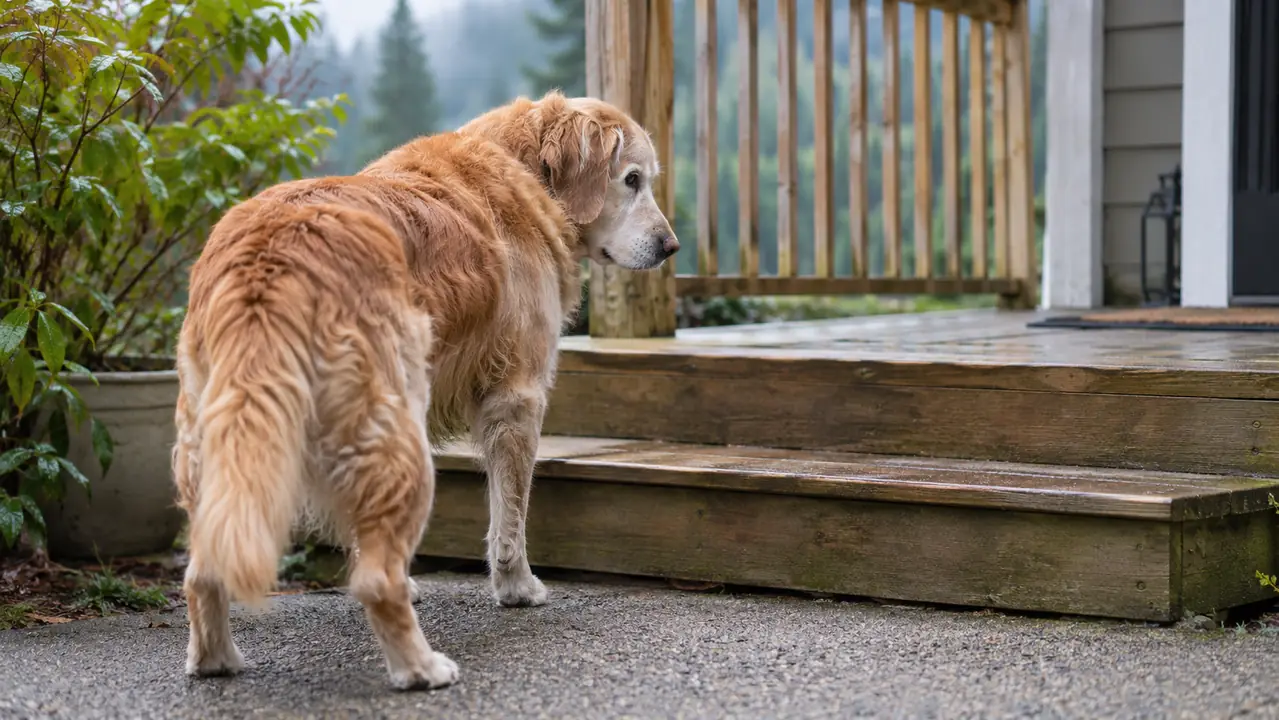
Tansy is eleven now, and what got my attention was not a limp. It was the pause. She would come down the hall and stop at the two back porch steps, front feet on the top one, and just stand there, like she was running the arithmetic. Three seconds some days, ten on others. Our vet had told me at her senior checkup that her hips and knees are showing age, no diagnosis past that, just the plain fact of an older dog whose back end had gone stiff. The pause is what sent me looking. Not the napping. Not the shorter walks. The pause.
I read a lot of labels in the feed store aisle and most of them I put back. I brought home the Natural Dog Company Wild Alaskan Salmon Oil, the 16 ounce bottle with the pump, because I wanted something I could put on Tansy's kibble without hiding a pill in a piece of cheese and holding my breath while she chewed around it. That was about four months ago. What follows is what I noticed, what took six weeks to notice, and what I would tell a neighbor before she spends her money.
The Quick Verdict
Pumps straight onto food, no fight at mealtime, and Tansy's coat came back softer. Her stiffness eased but did not vanish, and the first six weeks looked exactly like nothing was happening.
Amazon Check Today's Price →If your dog has started pausing at the porch steps, start here
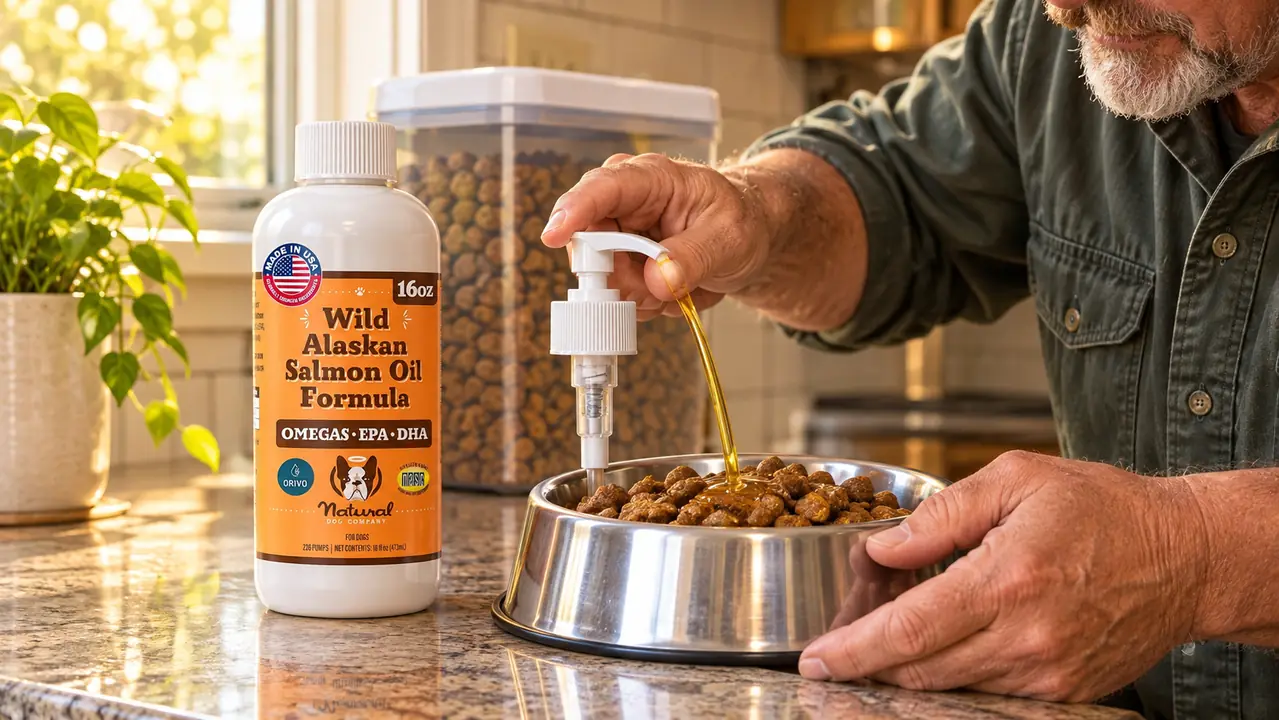
Wild Alaskan salmon oil, 16 ounces, with a pump that goes straight onto the food. Tansy never once noticed it was there.
Amazon Check Today's Price on Amazon →How I've Used It
The bottle lives on the counter beside the kibble bin, and that is most of why it stuck. A pump is a small thing until you have tried pouring oil from a wide-mouth bottle into a moving dog's dinner, which I have done, and which ends with oil on the counter and a fork to wash. Now I stand there with her bowl, give it a couple of pumps, stir it through with a fork, and set it down. From the very first bowl she ate it like nothing had changed. No turned-up nose. No leftovers left to congeal.
I followed the pump directions on the bottle and did not freelance with the amount, because Tansy is 58 pounds and I am not a veterinarian. I am a retired mail carrier. Twenty-nine years on one route outside Bend taught me to notice how a dog moves, and that is the only expertise I claim. I did call our vet before I added anything to her food, since she is already on her senior routine, and I would tell you to do the same. The answer I got was that it was fine to try, and to give it time.
Time turned out to be the hard part. I had built up an expectation from reading reviews that I would see something in a week or two. That is not what happened, and it is worth saying plainly, because if you quit at day fourteen you will decide it did nothing. It was past the one month mark before I could point to anything that was not me wanting to see it. The bottle lasted us a little over two months at her amount, so I had a fair stretch of it before I had to decide anything. I marked the start date on the calendar in the kitchen, the same one I write her vet appointments on, and I made myself look at it rather than guess. That calendar is the only reason I can tell you the timeline honestly instead of remembering it as faster than it was.
What the Label Says and What I Actually Checked
The Natural Dog Company bottle lists EPA and DHA, the two omega-3 fatty acids you will see named on every fish oil for dogs, plus omega-6. It lists joint health, skin care, heart health, digestive health, immune support and antioxidant among the benefits. That is a long list, and I read a long list with one eyebrow up. What I can tell you is what is printed there and what I saw in my own dog. I cannot tell you it cures anything, because it does not, and I would be suspicious of anyone who says it does.
I compare these bottles the way I compare anything, by turning them around and looking for the numbers. What you get here is the named set, EPA, DHA, omega-3 and omega-6, and I check for that before I read a single claim about what it will do for a dog. The oil is wild Alaskan salmon and pollock and it is meant as a food topper, not as a meal in itself. That matters to me, because I am not replacing her kibble. I am adding to it.
The bottle itself is 16 fluid ounces, about a pound, roughly two and a half inches square and eight inches tall. That fits in the narrow gap between my counter and the refrigerator, which sounds like a small thing until you have owned a supplement that did not, and ended up in the cabinet behind the coffee cans where you never see it again. Small details decide whether a bottle gets used. Before this one I had a chewable joint thing in a tub the size of a coffee can, and it lived on top of the refrigerator for five months because getting it down was one more step than I wanted at six in the morning. I threw most of it out.
I also weighed Tansy at the feed store once a month on the same scale, because a dog her age can lose a pound without you noticing, and a stiff back end can be a dog carrying extra weight rather than a dog with sore hips. She held at 58 pounds the whole four months. Her weight did not change, so the small improvements I noticed were not me accidentally putting her on a diet. If anything I expected her to gain a little, since oil is oil, and she did not.
What Changed, and When
The first thing that changed had nothing to do with her hips. Around week three I noticed my hand felt different on her back when I brushed her. Softer, less dry. Her coat had gone dull the way older dogs' coats do, and I had put it down to age and let it go. By week five there was a shine along her shoulders that I had not seen in a couple of years.
The porch steps took longer. Somewhere in week six I realized I had stopped counting. She came down the hall, went up the two steps, and I did not notice, because I was not watching for it anymore. That is a strange way to measure something, by the absence of your own attention, but it is honest. Nothing dramatic. No trotting. Just the pause quietly going away. I want to be careful here, because I have read reviews that make it sound like the dog was a puppy again by the second bottle. That was not my experience and I do not think it is most people's.
Getting up after a nap is better too. She still takes a second, and on a cold wet morning she takes longer, and I am not going to pretend otherwise. But the slow gathering of herself, the way she used to rock twice before getting her back legs under her, that is mostly gone. She stands up like a dog who is not thinking about standing up. The step up into the back of the Subaru is easier as well, though I still pat the tailgate and let her take her own time rather than lifting her, because lifting a 58 pound dog is a good way for both of us to get hurt.
What did not change is the kitchen floor. Her back feet still slide on the laminate when she turns too fast to check the doorbell. Oil does not fix traction. If you are reading this because your dog is skating across hardwood, the thing that helps is a runner rug, not a supplement, and I wish I had bought the rug first. I did both in the end. They do different jobs and neither one is the other one.
The Coat, Which I Did Not Expect
I bought this for her back end, so the coat was a side effect I was not paying attention to. It turned out to be the most visible thing. Her skin had been flaky along her spine, and the flaking is much reduced. She is still a German Shorthaired Pointer with short hair and she still sheds, but what comes off on the brush is less dry and brittle than it was in February.
I keep wondering whether I am crediting the Natural Dog Company oil for something a change in weather did, since we came out of winter into spring here in central Oregon. That is the trouble with a one-dog, one-bottle test. I can only tell you the sequence and let you weigh it. Four months, one dog, no control group, and a woman who very much wanted it to work.

The Parts I Don't Love
It smells like salmon, which should go without saying and which you should consider before you buy it. My kitchen smells faintly of fish for the minute it takes to stir it in. The bowl gets licked clean so the smell does not linger there, but the fork does, and I now keep a fork that is only for this.
The pump is good but it can drip at the spout, so I keep a small saucer under the bottle and wipe it every few days. The first couple of weeks I did not, and I ended up with a tacky ring on the counter that took scrubbing. That is my own housekeeping and not a defect, but you should know what you are signing up for before it is on your counter.
And here is the honest part. This is one more thing in the day, every day, until something changes. It is not a course you finish. Every morning, the bowl, the pump, the fork. That is fine for me at 63 with one dog in a one-story house and a gravel driveway I no longer have to walk in the rain. It would be a bigger deal in a busy household with three dogs and somebody rushing out the door at seven. There was one week in March when I was down with a cold and staying with my sister in Redmond, and I measured out what Tansy would need into a little jar and left written instructions on the counter. It got done, but it was a nuisance, and I would rather tell you that than pretend the habit is weightless.
What I Liked
- Tansy took it from the first bowl, no coaxing and nothing left over
- The pump goes straight onto kibble, so there is no pill to hide and no measuring spoon to wash
- Softer, less flaky coat by week five, which I did not expect to care about
- Somewhere in week six she stopped pausing at the porch steps
- Bottle fits a narrow counter gap and lasted us a bit over two months
Where It Falls Short
- It takes weeks, not days. Quit at two weeks and you will see nothing
- It smells like fish, and so does the kitchen for a minute each morning
- The pump spout can drip, so plan on a saucer underneath
- Does nothing for slipping on hard floors, because that is a traction problem
- It is a daily habit you have to keep buying for, month after month
Somewhere in week six I stopped counting her steps. She came down the hall, went up the two porch steps, and I was not watching anymore.
Who This Is For
If you have an older dog who has started hesitating, this is a reasonable thing to try, and it is the one I would try first because it is easy to give. The dogs who seem to do best with it are the ones like Tansy. Eight and up, a little stiff in the back end, coat gone dull, still eating well, still wanting the walk. It also suits a household that has already decided not to fight over pills. There is no battle here. The food goes down and the dog never knows.
I would also say this, and I say it every time. Bring it up with your vet first. Not because there is anything frightening about salmon oil, but because a stiff older dog deserves a proper look, and because your vet knows things about your dog that I do not know about mine. Ours gave a plain answer and it helped me decide. That conversation costs you a phone call and it is worth the phone call.
Who Should Skip It
Skip it if you need to see a change this week. Four months in, I would call what I saw steady improvement in comfort and in coat. I would not call it fast, and no bottle is fast. Skip it too if your dog's main trouble is slipping on the floor, because that is a traction problem and a food topper will not touch it. Buy the runner rug first. Then come back to this.
And skip it if your dog has a fish allergy, or if your vet has told you to keep the fat in the diet low for a specific reason. I am not in a position to sort that out for you and I would not try. Tansy had the all clear and I still started slow and watched her for the first week. That is the whole of my advice. Ask your vet, start slow, give it six weeks before you judge it, and do not credit a supplement for a season changing.
Four months, one stiff old pointer, and a bottle that stayed on the counter
If Tansy's pause at the steps sounds like your dog, this is the bottle we are still using. Pump it on the food, stir it in, and give it six weeks before you decide.
Amazon Check Today's Price on Amazon →