
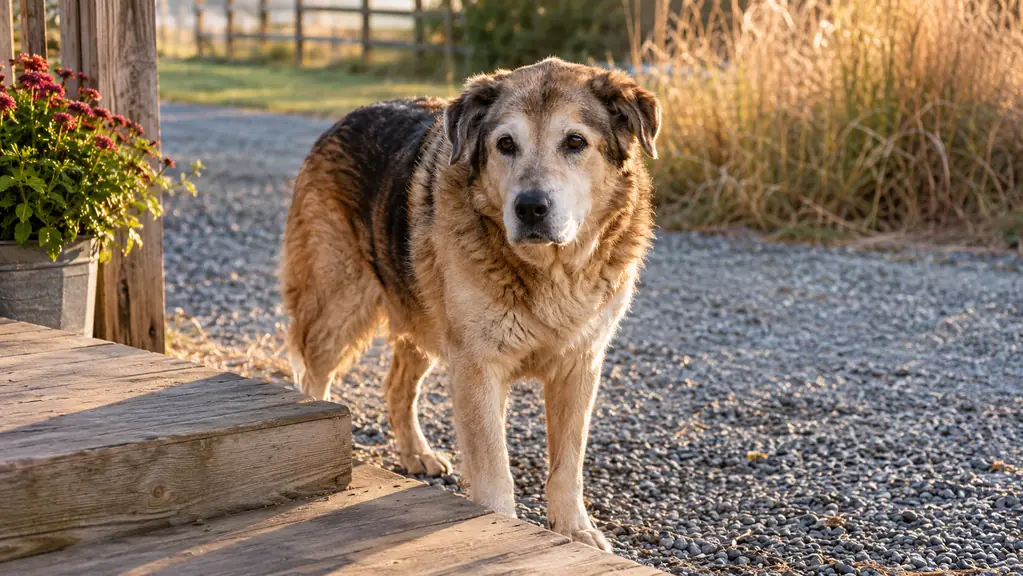
Tansy stopped at the top of the two back porch steps and stood there, working something out. Eleven years old, fifty eight pounds, liver and white, and still the first one to the truck when the tailgate comes down. It is the back end that has gone cautious. She is slow to stand after a nap on the rug. She thinks about the step up into the Subaru. Her back feet slide on the kitchen laminate in a way that makes my stomach drop every time it happens. Our vet has seen her for a senior checkup and said her hips and knees are showing age. No drama to it, just age. One of the things she suggested we could try was an omega 3 supplement, and that is how I ended up in the feed store aisle with my reading glasses pushed up on my head, holding a bottle of Natural Dog Company Wild Alaskan Salmon Oil in one hand and a bottle of fish oil capsules in the other.
The short answer, if you are standing in the same aisle: the Natural Dog Company Wild Alaskan Salmon Oil, a 16 fluid ounce bottle with a pump, is the easier one if your dog eats a wet topper without complaint and you want to fine tune the amount. Fish oil capsules are easier if your dog already takes pills, if you travel with your dog, or if a fishy smell on the kibble makes your dog walk away from the bowl entirely. That is the whole decision in two sentences. The rest of this is what actually happened in my kitchen over six weeks.
How the Two Compare at the Bowl
I wrote each row below from the label and from what happened in my own kitchen. Where the capsules honestly did better, the row says so. There is no sense in pretending otherwise, because you will find out on the first morning your dog refuses the bowl.
What that aisle taught me is to stop reading the front of the bottle. Both of these are selling omega 3, and the useful numbers are EPA and DHA per serving, not the size of the bottle or the picture of a salmon on it. So I stood there with a pen and wrote on the back of an envelope: what counts as a serving, how many servings are in the container, and what one serving actually delivers. The salmon oil lists its EPA and DHA and names wild Alaskan salmon oil along with pollock oil. For a capsule bottle, the same three questions apply, and if the label will not answer them plainly, that is your answer.
| Natural Dog Company Salmon Oil | Fish Oil Capsules | |
|---|---|---|
| Form | 16 fl oz liquid salmon oil in a bottle with a pump | Fish oil in soft gel capsules |
| Getting the amount right | The pump puts a repeatable amount straight onto the kibble | You count soft gels out of the bottle |
| Adjusting for a 58 pound dog | Easy to go up or down a little at a time | Fixed capsule size, so you are choosing between two and three |
| A dog that cleans the bowl | Nothing to hide, it goes on the food | Has to be swallowed whole |
| A dog suspicious of wet food | A strong fish smell on the kibble can put a picky dog off the whole bowl | The smell stays inside the capsule, and cheese hides the rest |
| Travel and boarding | A bottle and a pump to pack and keep upright | Capsules go in a bag or a pill organizer |
| What the label tells you | Names wild Alaskan salmon oil and pollock oil, with EPA and DHA listed | Read the EPA and DHA per soft gel on the bottle you pick up |
| Best for | Dogs that eat toppers and owners who want to fine tune | Dogs already on pills and households that travel |
Read that table back and you will notice something. The oil wins on the mechanics of giving it, the capsules win on the mechanics of carrying it, and neither one wins on what is inside, because inside they are chasing the same thing: EPA and DHA from fish.
Where Natural Dog Company Salmon Oil Wins
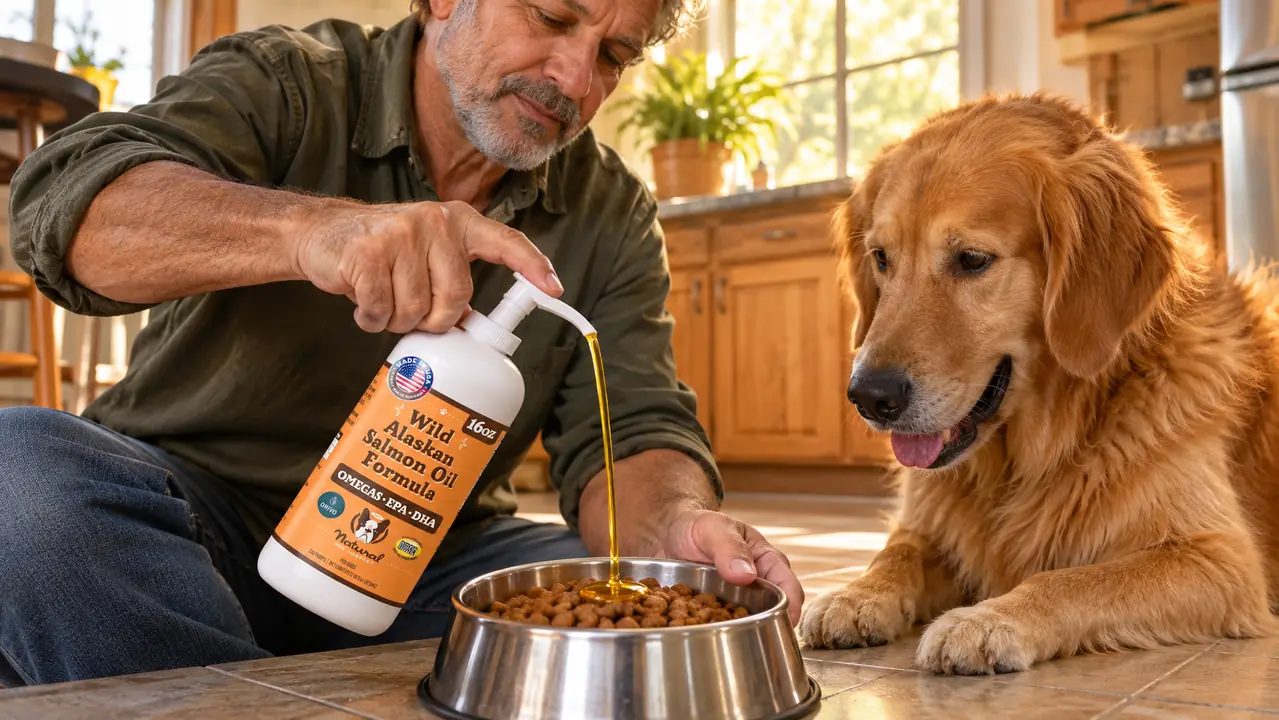
The pump is the reason I stayed with the oil. A capsule dose is whatever size the capsule is, and for a fifty eight pound pointer that put me somewhere between two and three soft gels, which is a guess dressed up as a measurement. With the bottle, the pump gives me the same amount each time and I follow the serving chart on the label for her weight. When our vet said we could nudge the amount, nudging was a small change rather than half a capsule more. For a dog this size, that flexibility matters more than it sounds like it would.
The second thing is that it goes on the food. Tansy has never been a pill dog. She will take a capsule if it is wrapped in a piece of cheese, and then she will spend the next minute carefully eating the cheese and spitting the capsule onto the floor, and we will both pretend that did not happen. Oil on top of her kibble is not a negotiation. She licks the bowl and looks at me for more. Six weeks of a thing your dog takes without a fight beats a better thing your dog refuses twice a week, and that is not a small point. That is most of the point.
I tried the capsules first, if you want the honest order of things. Five mornings in a row I wrapped a soft gel in a quarter inch of cheddar and Tansy ate the cheddar and left the capsule on the floor where I would find it later with my bare foot. On the fifth morning I found three of them lined up under the kitchen table like a small protest. That is when I went back to the feed store and came home with the bottle. The pump sits on the counter beside the food bin now and the whole job takes about four seconds at twenty to seven in the morning, which is the only test that matters for anything I am supposed to do every day for a year.
The label is also readable. It names wild Alaskan salmon oil along with pollock oil, and it lists EPA and DHA. The listing names the areas people buy it for: joints, skin, coat, heart, immune support, digestion, antioxidant. I am careful with that list. It is a list of what the oil is used for, not a promise about your dog's hips. What I can tell you honestly is that this is the version I have managed to give every single morning without missing, and consistency is most of the battle with anything you are trying for an older dog.
Where Fish Oil Capsules Win
If your dog is fussy about what touches the kibble, the capsule wins and it is not close. Tansy is not fussy, but my neighbor's terrier is, and a dog like that will sniff a fishy bowl once and walk off as if you have insulted the family. A soft gel keeps the smell inside. You hide it in something better and the dog never knows. For those dogs, the capsule is the difference between a supplement that happens and a bottle that sits in the cupboard until it goes off.
Travel is the other place the capsules win. We drive to the vet in Bend and we take one trip a year to see my sister, and the bottle has to be packed upright and kept from rolling around in the back. A bag of soft gels fits in the glove box. If you leave your dog at a boarding kennel or with a neighbor, the instructions for capsules are one line long: two with breakfast. A bottle with a pump means explaining the serving chart, and hoping the person doing it reads it the same way you do.
My neighbor Carol keeps her sister's terrier for two weeks every summer, and she has a laminated card on the fridge with that dog's pills written out. Two of these, half of that, one of the little ones at night. A liquid would mean a second card with a chart on it. When you are handing your dog to someone else for a week, you want the instruction to be a number you can say out loud over the phone, not a serving table taped to a bottle. That is not a knock on the oil. It is just what happens when more than one person feeds the dog.
There is one more thing I will give the capsules, and it is not really a feature. They feel like a routine you already know. Most of us over fifty have a pill organizer in the house. Handing the dog a soft gel in a piece of cheese is a familiar motion, and familiar motions are the ones that get repeated on a wet Tuesday when you are running late.
If Your Dog Eats Toppers, the Liquid Is the One You Will Actually Keep Using
This is the bottle that made it onto Tansy's bowl every morning: 16 fluid ounces of wild Alaskan salmon oil with EPA and DHA, in a pump bottle that measures straight onto the kibble. No pill to hide, no guessing at half a capsule.
Amazon Check Today's Price on Amazon →Six weeks in, her coat felt softer and she got up from the rug a little more smoothly most mornings. The porch steps were still porch steps. That is the honest version.

What Six Weeks Looked Like, and What It Did Not
I want to be straight with you, because plenty of reviews are not. Six weeks in, Tansy's coat was noticeably softer under my hand and the dandruff along her spine had settled down. She stood up from the rug a little more smoothly on most mornings, though not every morning, and not in any way you could call dramatic. What I did not get was a different dog. She still takes the porch steps one at a time and thinks about it first. She still hesitates at the tailgate. Anyone who tells you a bottle of fish oil changed that is selling something, and I am not going to do it.
I kept a note on the kitchen calendar, which sounds more organized than it was. Week one, nothing I could point to, and I nearly stopped. Week two, she had a rough morning after a long Sunday in the yard and I nearly stopped again. Weeks three and four, the coat change, which was the first thing I was sure of and the only thing I would have bet money on. Week five, our vet's office called to check on her and I said the same thing I am writing here: easier getting up most mornings, steps unchanged. Week six I quit counting and just kept the bottle by the food bin, which I think is what sticking with something actually looks like.
I also did a few things that cost nothing, and I have to be honest that they are probably half the story. I put a cheap runner along the kitchen counter where she slides. I put a mat at the bottom of the two back steps. I cut her evening walk shorter and let her stop and sniff as long as she wants, which she enjoys more than the distance we used to cover. If you are chasing slippery floors, the floor matters as much as anything in a bottle.
Who Should Buy Which
Buy the Natural Dog Company Wild Alaskan Salmon Oil if your dog eats a bowl of food with enthusiasm and you want to be able to adjust the amount by small increments as your dog's weight or your vet's advice changes. It also suits a household that stays put. The bottle lives next to the food bin, the pump goes on the kibble, and the whole thing takes four seconds. If you have a dog that licks the bowl, this is the low-friction answer.
Buy fish oil capsules if your dog is already on pills and takes them without a fight, if your dog turns its nose up at anything wet on the kibble, or if your dog travels with you or gets boarded regularly. Capsules are also a reasonable choice if someone else feeds your dog part of the week, because the instruction is a number instead of a chart. Pick a bottle that lists EPA and DHA per soft gel so you can compare it honestly against any liquid.
And whichever you pick, talk to your vet first. I am not a veterinarian. I carried mail on one rural route for twenty nine years, and what that taught me is how to notice when a dog moves differently, not how to diagnose anything. Tansy had a senior checkup and our vet told us her hips and knees are showing age, and we made this decision with her. If your dog is on other medication, or has a diagnosed condition, that conversation comes before anything you put in the bowl.
Ask Your Vet, Then Give It Six Weeks Before You Judge It
Nothing about an older dog changes overnight. The bottle with the pump is the version I could keep up with every morning, and six weeks is a fair stretch to know whether it is doing anything for your dog at all.
Amazon Check Today's Price on Amazon →