
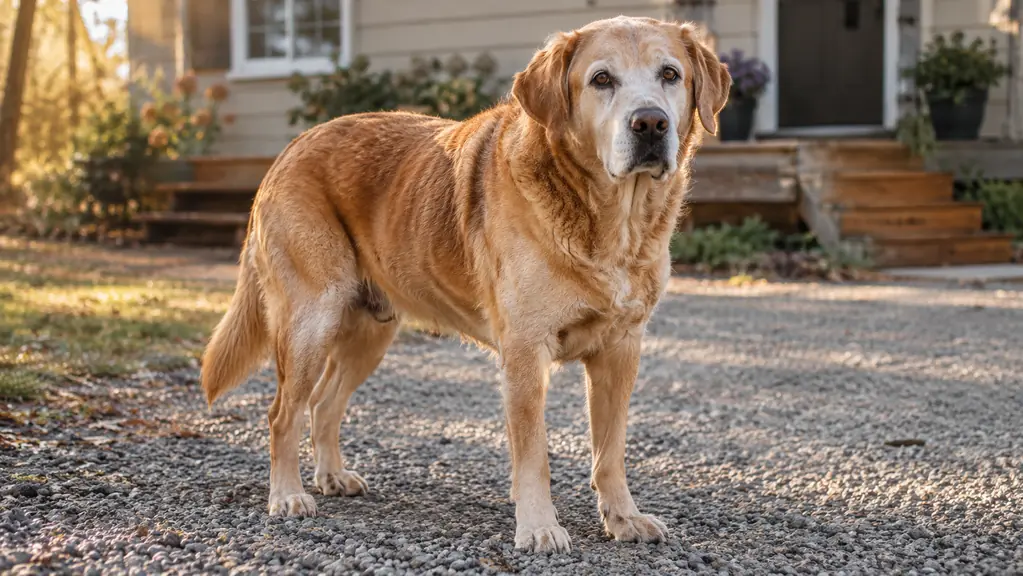
Tansy is eleven now, a German Shorthaired Pointer who still treats the word walk like a starting gun. What changed is the getting up. After a nap on the rug she takes a beat, then another, then pushes herself upright with her front end doing most of the work. She stops at the two back porch steps and stares at them like they are a math problem. On the kitchen laminate her back feet slide out from under her when she turns too fast. Our vet did a senior checkup this spring and said what I already suspected. Her hips and knees are showing age. Not a crisis, not surgery talk, just the plain fact that an older dog's joints need help and that her weight and her movement matter more than anything I could buy. What I could actually control was her bowl, and the bottle I settled on for it was Natural Dog Company Wild Alaskan Salmon Oil.
I am not a veterinarian. I carried mail on one rural route outside Bend for twenty-nine years, and three decades of watching dogs come down driveways taught me to notice how a dog moves. That is the whole of my expertise, and I will not pretend it is more. What follows is not a treatment plan. It is the five-step routine I use to add omega-3 salmon oil to a senior dog's food, using the bottle currently sitting on my kitchen counter. I will tell you what I did, what took weeks to show, and the two bottles I bought before this one that I should have skipped.
The Bottle That Is Actually On My Counter
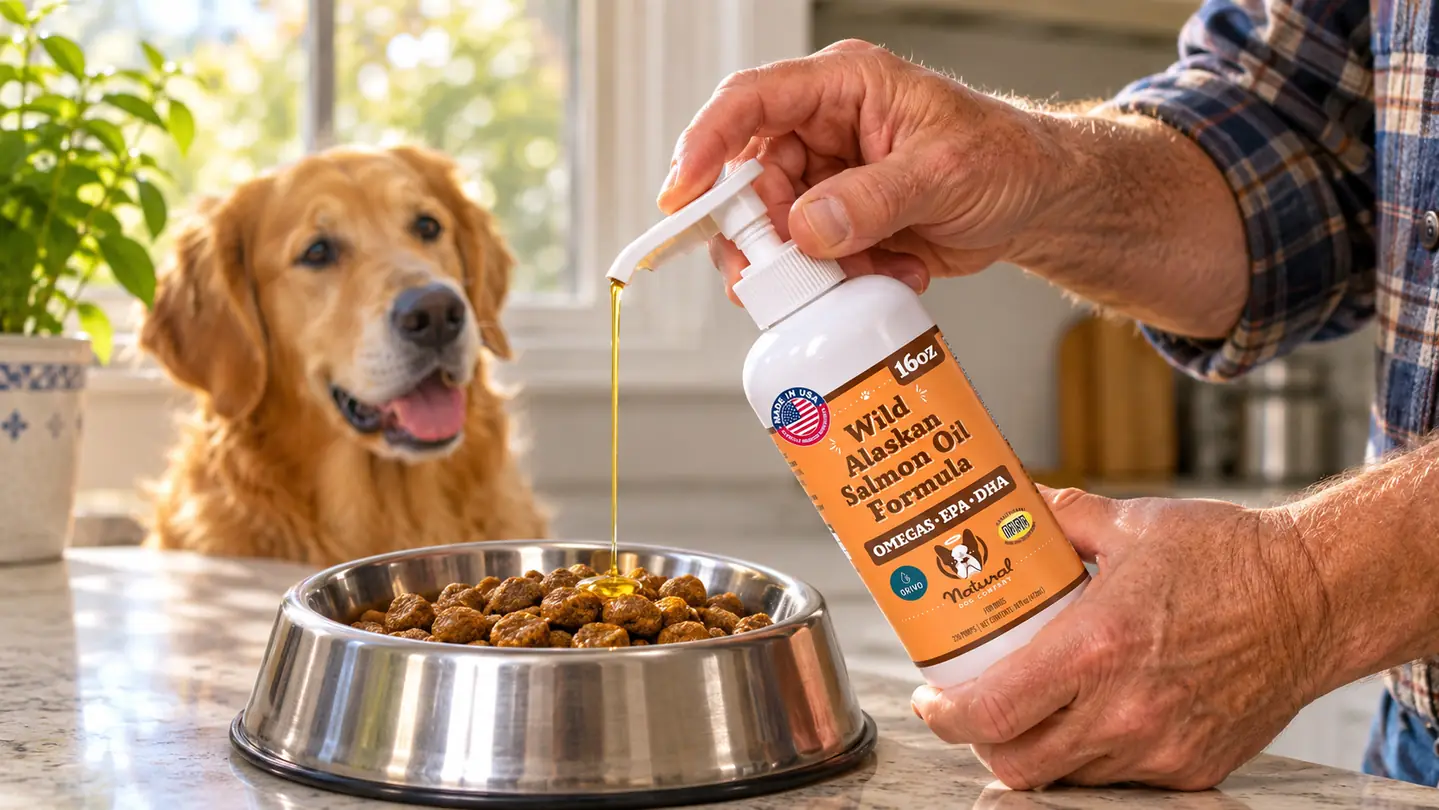
Sixteen fluid ounces of wild Alaskan salmon oil with a pump that goes straight onto the bowl. It is the one I settled on after reading a lot of labels and getting it wrong twice. Tansy gets it over her kibble every evening.
Amazon Check Today's Price on Amazon →Five Steps for Putting Salmon Oil in a Senior Dog's Bowl
Step 1: Call Your Vet Before You Buy a Bottle
This is the dull step and it is the one I nearly skipped. I had a bottle in a cart online before I thought to pick up the phone. Our vet asked three things I would not have thought of: what else Tansy was taking, whether she had ever had a bout of pancreatitis, and when her last bloodwork was done. Fish oil is not nothing. It adds calories, it can matter if a dog is on certain medications, and it is the wrong choice for some dogs with a sensitive pancreas. The answer for my 58 pound pointer is not automatically the answer for your dog.
The call took eleven minutes. I had six questions written on the back of an envelope and I got through all six, which surprised me. I wrote the amount the vet gave me on a sticky note and taped it inside the cabinet door, right where I keep Tansy's bowl. For the first two weeks I read that note every single evening before I measured anything out, because I did not trust my memory and I was right not to. Sixty-three years old and I still cannot hold a number in my head from the kitchen to the counter.
I also asked what would tell me to stop. Loose stool, vomiting, a dog who suddenly turns her nose up at dinner, or itchiness that was not there before. I wrote those four down in the same notebook and checked them against her for the first ten days. Knowing that in advance meant I was not trying to make a judgment call at nine at night with a worried head on. If your dog has a fish allergy or your vet wants a single source oil, that is a conversation to have before the bottle arrives, not after.
Step 2: Read for EPA and DHA, Not Just the Omega-3 Headline
Fish oil labels love a big number on the front. What matters is how much of the omega-3 inside is EPA and DHA, the two long-chain fats you are actually paying for. A bottle can advertise a large total and still be thin on those. The Natural bottle lists EPA, DHA, omega-3 and omega-6 right on the label, which is more than a lot of them tell you. I have stood in the feed store in Bend with three bottles in my hands, turning each one over and over, and two of the three told me almost nothing.
Compare milligrams per serving, not bottle size. Sixteen fluid ounces sounds generous until you work out how many days it covers at the serving printed on the back panel. I did that math on my phone, in the aisle, twice, because I am the kind of person who reads the back of a cereal box. The bottle I use lasts Tansy roughly two months at her amount, which is the sort of thing worth knowing before you start rather than halfway through.
Check the species too. This one is wild Alaskan salmon oil and the listing also mentions pollock oil, which is common in fish oils and fine by me. If your vet wants one source and one only, read the ingredients list before you buy rather than after the box is open on your counter.
Step 3: Start With Half of What the Bottle Suggests
Whatever the pump guidance on the bottle says, and whatever number your vet gave you, start low. I gave Tansy about half her target amount for the first week, then stepped up over the following ten days. She is a dog who has never had a sensitive stomach in her life and I still did it this way, because a senior dog does not need a new problem layered on top of an old one.
On day four the stool went soft. Not alarming, just softer than hers has ever been, and I dropped back to the smaller amount for another week before trying again. That is not a failure, that is the adjustment working exactly the way it should. By the end of the second week she was at the full amount and nothing about her evenings had changed at all.
The sign you went too fast is almost always the stool. Soft, greasy, or suddenly urgent at two in the morning. If that happens, drop back to the smaller amount for a week and try again. If it keeps happening, stop and call your vet. A lot of people give up on a fish oil at this point and decide it does not agree with their dog, when the truth is they simply started at the full line on day one.
Keep everything else about the meal the same while you do this. Same kibble, same times, same treats. If you change three things at once you will never know which one caused what, and you will be back to guessing.
Step 4: Pump It Over Warm Food and Stir It In
The bottle comes with a pump in the cap, and it goes directly onto the meal. I set Tansy's bowl on the counter, press the pump over the kibble, and then stir it through with a fork. Stirring matters. If it pools in one corner she eats around it and then looks at me like I have insulted her.
I add a splash of warm water from the kettle first, just enough to take the chill off, never hot. Warm kibble takes the oil better and it makes the whole bowl smell like something worth standing up for, which on a stiff evening is not nothing.
The first week I made a mess twice. Once I pumped before the bowl was sitting level and oil ran down the outside of the bottle onto my hand. Once I forgot the fork and found a slick patch of untouched kibble at the bottom of the bowl. Two small habits came out of that. I wipe the pump nozzle with a paper towel after every use so it does not gum up and dribble down the side, and I keep the bottle on a small plate in the cabinet, because oil finds its way out eventually and I would rather it found the plate.
Step 5: Give It Six to Eight Weeks and Write Things Down
The coat changed first. Around week five I noticed I was not sweeping up quite as much loose hair, and her back felt softer under my hand. That is the part people notice early and it is the least important part, honestly, but it told me the oil was going in and staying down.
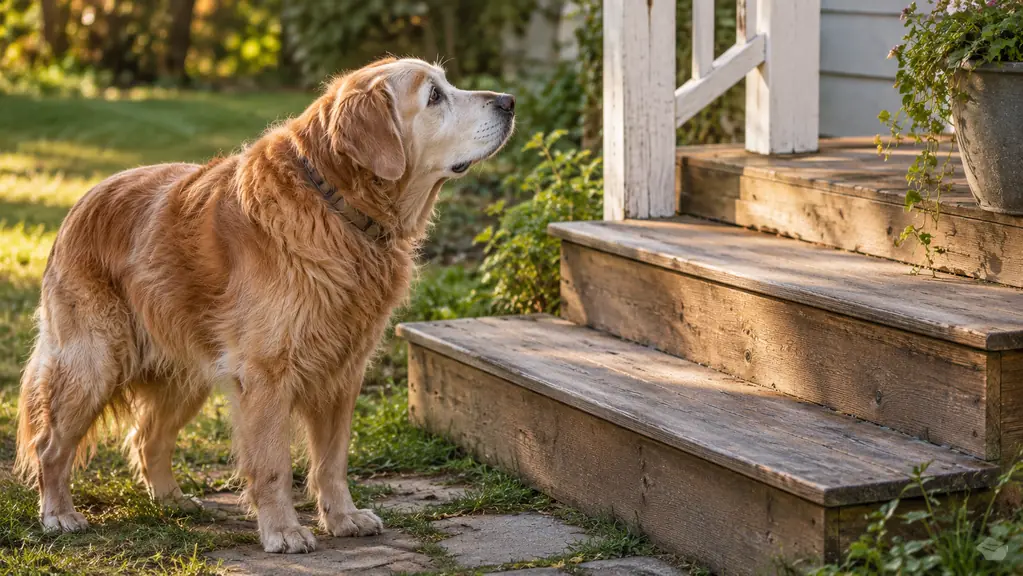
The movement took longer, and this is where I want to be careful with you. Week seven is when I noticed her standing up in one motion instead of two. Nothing dramatic. No leaping. Just less of a production. She still sizes up the porch steps before she takes them, but she takes them.
Week seven is when I noticed her standing up in one motion instead of two. Nothing dramatic. Just less of a production.
There was a Tuesday in late September, cool and clear, when she came out of the bedroom after a long nap and was simply standing in the doorway before I had finished tying my shoes. No two-stage push, no pause. I wrote it in the notebook that night, then flipped back to the entry from the first week of August, and the difference was sitting right there in my own handwriting.
Day to day you will not see it, because you are looking at the same dog every morning. That is why I wrote it down. Three lines in a notebook on the counter: how long it took her to stand after a nap, how far we walked, and whether she took the porch steps or stopped at the bottom. Four weeks of those notes will tell you more than any amount of squinting at your dog and hoping. Bring the notebook to the next checkup. Our vet read mine in about ninety seconds and it was worth more than anything I could have said out loud.
What Else Helps
The oil is the smallest part of this, and I would be lying to you if I said otherwise. Getting Tansy down about four pounds on the vet's scale did more for how she moves than any bottle ever has. Four pounds on a fifty-eight pound dog is not much on paper and it is the difference between a hard morning and a fair one. If your dog is carrying extra weight, that is the first lever, and it is a lever your vet should be the one to set.
Traction on the floors was the second thing. I bought a cheap runner from the hardware store and laid it down the kitchen, and her back feet stopped sliding out from under her when she turned. It is not pretty. It is the single most useful thing in this house.
The third is the car. Tansy rides in the back of the Subaru Outback and the hop up had turned into a scramble. A folding ramp leaning against the wall in the garage fixed it in one afternoon, and now she walks up it like she has always done it that way. Shorter walks, more often, also beat one long walk that leaves her stiff for the rest of the day. I warm her up with a slow sniff around the yard before we go anywhere, and I let her set the pace. She is eleven. She has earned the right to stop and smell things.
Keep the oil in the routine, whatever else you change. Two weeks on and four days off tells you nothing. The dogs who seem to do well on a fish oil are usually the dogs whose people did the same sensible thing every evening for two months and then kept doing it. That has been the whole of my method with the Natural bottle, and it is the whole of my method with everything else in this house.
Start Low, Stay Steady, Then Judge It in Eight Weeks
Sixteen fluid ounces with a pump that measures straight onto the bowl. Call your vet for your dog's amount first, start at half, and give it two months before you decide anything. That is the whole method.
Amazon Check Today's Price on Amazon →