
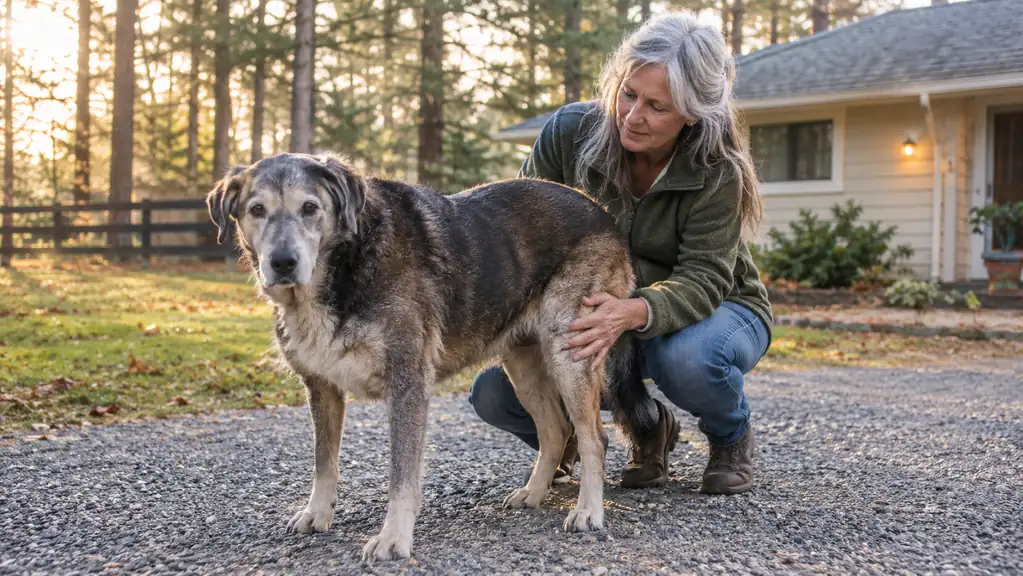
The thing nobody tells you about an old dog is that the decline does not arrive as a diagnosis. It arrives as a pause. Tansy is an eleven-year-old German Shorthaired Pointer, fifty-eight pounds on our vet's scale, and for most of last year she was fine. Then in spring she started standing up in stages. Front legs first, then a long beat where she seemed to be thinking it over, then the back end. I bought the LOOBANI dog lift harness for large dogs in June, not after months of research, but because I had already tried two other things that did not work and I was tired of watching her hesitate at the two steps off the back porch.
This is the honest version of that purchase, including the parts I would want to know first. It is not a cure and it is not a fix. If you are hoping a length of nylon will reverse anything, it will not. What it does is narrower and more useful than that. It lets me take some of Tansy's weight for thirty seconds at a time, so she can still do the things she wants to do. The LOOBANI sling has been hanging by my back door since June. Here is what six months of real use looks like, good and bad.
The Quick Verdict
A well-made sling that does one job properly. It will not fix your dog and it will not fix your floors, but it will get her down the porch steps without a fall.
Amazon Check Today's Price →The thing that got Tansy off the porch and back into the yard
Nylon, machine washable, thick sheepskin-like lining, and it folds into its own bag for the car. The one I have reached for every single day since June.
Amazon Check Today's Price on Amazon →How I've Used It
Tansy gets a senior checkup twice a year, and at the spring one our vet said what I already suspected, that her hips and knees are showing age. No dramatic announcement, just an old dog with old joints. The advice was practical. Keep her moving, keep her lean, help her where she struggles, and do not let her launch herself off furniture. That last part is the reason I bought the sling.
In practice I use it four or five times a day, in short bursts. Mornings, to get her up off the rug after a nap. The two back porch steps, going down more than going up. The step into the back of the Subaru Outback, which she used to take at a run and now stands in front of and considers. And the laminate floor in the kitchen, which she crosses like a skating rink if I let her. None of those are big events. Most of them take less time than it took you to read this paragraph.
What surprised me is how much of the work is mine and not the sling's. You do not put it on and walk away. You hold it, you take weight, you read the dog, and you let go the moment her feet are under her. The first week my timing was bad and I was more hindrance than help. By the third week it had become as automatic as holding a door for someone.
I wash it about every ten days. The care tag says machine wash, and the whole thing goes in with the dog towels and comes out clean. It folds into the little storage bag it came with, which now lives in the car, because the step into the Outback is the one place I need help away from home.
It Is a Sling, Not a Harness, and That Changes How You Use It
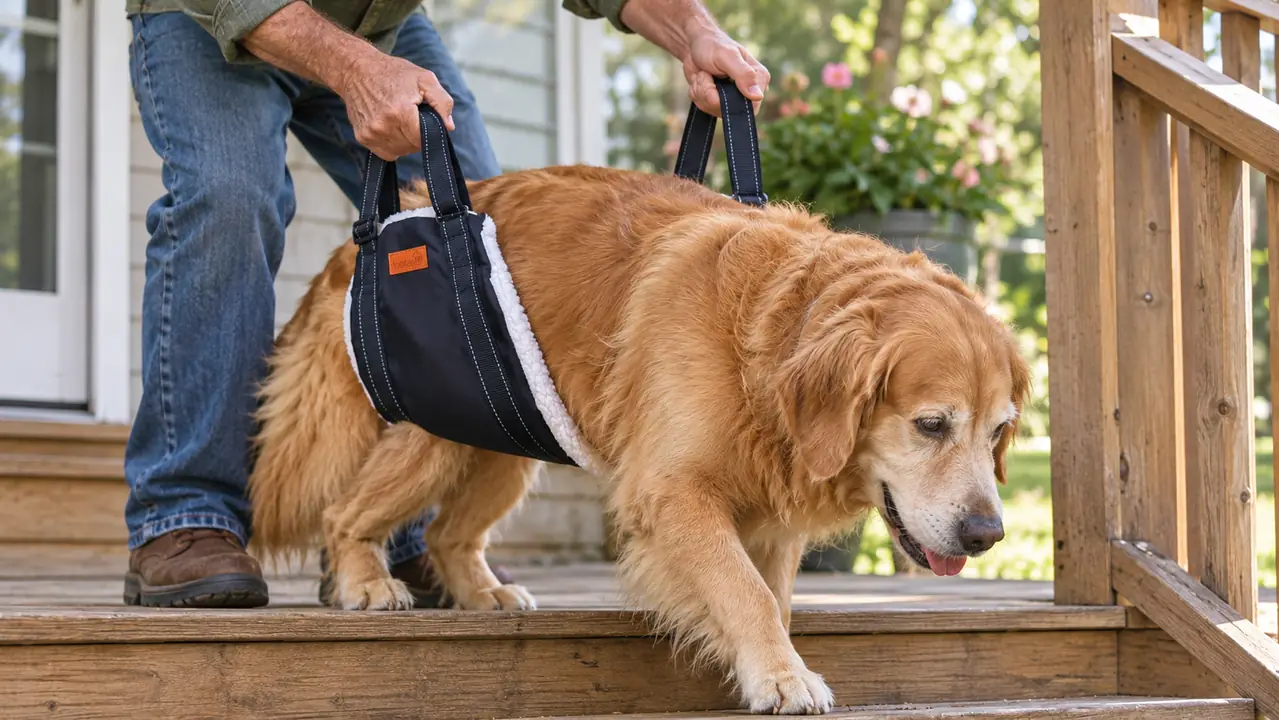
The word on the package is harness, and that word sets the wrong expectation. A harness goes on the dog and stays on. The LOOBANI sling works differently. It is a band of nylon with a thick, soft, sheepskin-like lining that goes under the hindquarters, and you take up the slack until you are carrying part of the back end instead of all of it. It goes on when you need it and comes off when you do not.
That distinction matters more than it sounds. If you are picturing something the dog wears around the house all day, this is not that, and honestly I would not want it to be. For one thing, a dog should use her own legs as much as she safely can. The sling is there for the twenty seconds when her legs need help, not to do the walking for her. For another, Tansy tolerates it exactly as long as it is useful and not one second longer. She has learned the sound of me picking it up, and she walks to the steps on her own.
The lining is the part I did not expect to care about. It is thick and it is soft, and on a fifty-eight pound dog with thin old skin, that is not a small thing. I have used a folded bath towel in a pinch, and while it technically works, the edge of a towel digs into the belly and the dog tells you about it immediately.
The First Two Weeks Are Awkward for Both of You
I want to be straight about the learning curve, because nobody mentioned it to me. The first time I put it under Tansy she did a small sideways dance and looked at me as though I had suggested something improper. The first time I lifted, I took too much weight and she scrambled. The second time I took too little and she lurched, which is worse, because a lurch is how a dog pulls something.
What works for us is to take up the slack slowly until I feel her settle, rather than lifting her off the ground. Think of a hand under an elbow, not a forklift. I also say the same word every time, up, before I take any weight, so she is never surprised. Three weeks in, she started leaning into it before I asked, which is the closest thing to a thank you I am going to get from a pointer.
The other thing nobody tells you is that your own back has an opinion. You are bending over a dog that is low to the ground, several times a day, usually in a hurry. If you have a bad back, work out how you are going to stand before you start, or have someone else do the lifting. I am sixty-three and I felt it in my lower back before I felt it anywhere else.
Where It Genuinely Helped
The porch steps. This is the change that altered our routine. Before the sling I had stopped letting Tansy out the back door on her own, because those two steps down were a coin flip and I was afraid of a fall. Now I stand at the top, take a little weight, and she goes down on her own four feet. She gets to be in the yard in the morning again, sniffing the fence line, which she had effectively lost for two months.
The car. Getting into the Outback used to be a launch. Now it is a step, with me holding the sling and letting her do the pushing. She still hesitates, but she does it. And I am not lifting fifty-eight pounds of unhelpful pointer into a vehicle, which at my age was never going to be a plan that lasted.
Standing up after a nap. This is where I saw the most change and it is the least dramatic to describe. It used to take her three separate tries. Now, with a little support under the hindquarters for the first few seconds, it takes one. She is not faster. She is just less worn out by the process of getting vertical.
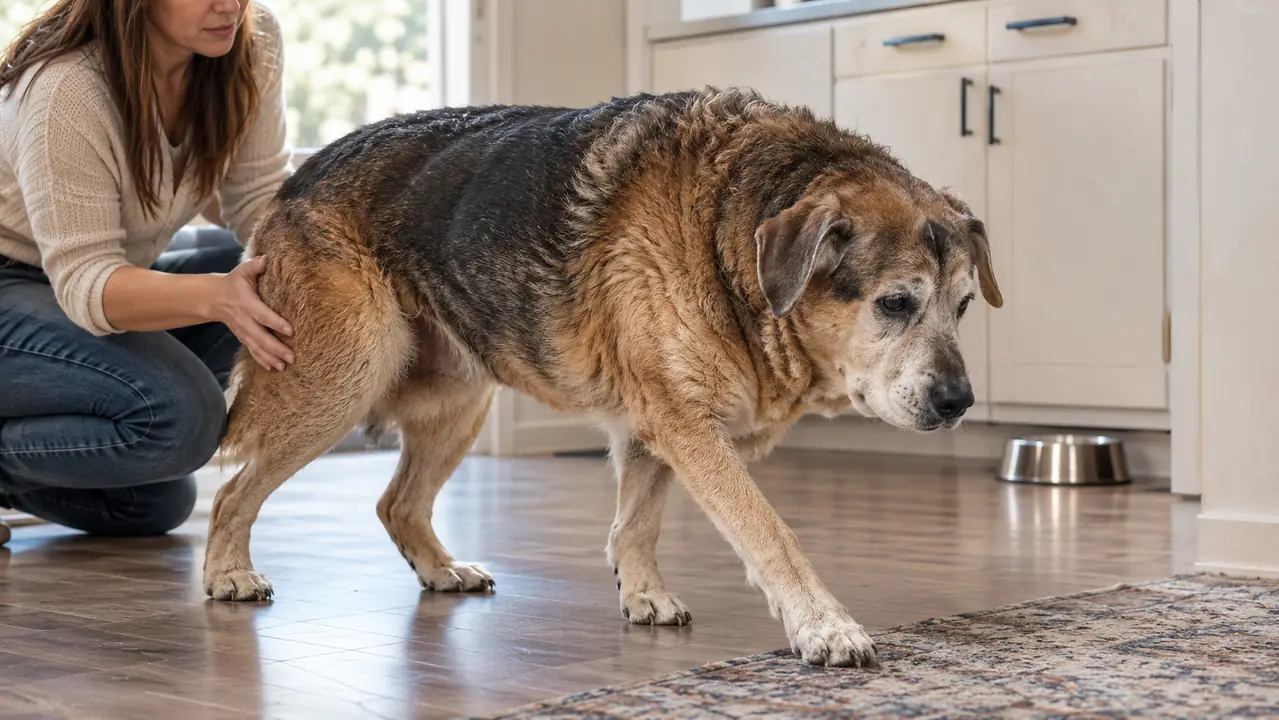
And the floors. I want to be careful not to oversell this, because the sling does not make a laminate floor less slippery. What it does is let me get her across the kitchen to the rug at the hallway without her back feet going out from under her. The floor is still the floor. I still need to deal with that separately, and I have not yet.
It used to take her three separate tries to stand up after a nap. With a little support under the hindquarters for the first few seconds, it takes one.
What Six Months Actually Looks Like
I keep a small notebook of things I notice, because at some point every old dog owner starts doing that. What it shows is not a curve going up. It shows a flatter line than the one we were on in May, and a dog who is still doing her own walking. In June she was hesitating at the top of the porch steps for a count of five and sometimes turning around. In September she walks to the top, waits for me, and goes down. That is the whole result, and around here it is a large one.
The LOOBANI sling has not changed how much she wants to go. She is a pointer and she has always wanted to go. It has changed what I am willing to let her attempt. Two months ago I would not have walked her down the gravel driveway to the mailbox and back, because the driveway is uneven and I could not catch her if the back end went. Now I can, so we do, most mornings. Some of that is the sling. Some of it is that I am less afraid, and a dog reads that.
What has not changed is the arthritis, or whatever our vet is seeing on the X-rays. Nothing in a nylon sling touches that. It sits in the drawer beside the joint supplement and the ramp I bought and never got around to installing, and it does its one small job, every day, without fuss. I think of it the way I think of the handrail by my own front steps. It does not repair my knee. It just means I take the stairs.
Where It Does Not Help At All
Nobody selling a lift sling is going to volunteer this part, so I will. It does nothing for the front end. If your dog's trouble is in the shoulders or the wrists, this is the wrong tool and you will be frustrated with it. It does nothing for a dog who cannot bear weight at all on the back legs either. That is a conversation with your vet, not a piece of equipment from a website.
It does not fix the floor. I said that once already but it bears repeating, because slippery footing is a separate problem with a separate answer, and I let the sling stand in for a real solution for about a month longer than I should have. If your dog is sliding, deal with the sliding.
It is also not something you leave on the dog. There is no delicate way to say this. If you strap a sling around a dog's hindquarters and walk away, you have created a hazard, not a help. It is an in-the-moment tool. I use it for a minute or two at a stretch, and the rest of the time it hangs by the door.
And the sizing. Mine is extra large, which is right for a fifty-eight pound dog, but it is generous on her. If your dog is closer to forty pounds with a long body, expect to gather a good deal of slack. Measure before you order rather than guessing, because returning things is a chore nobody needs in the middle of all this.
What I Liked
- Nylon wipes clean of mud and worse, and the care tag says machine wash. Mine has been through the machine a dozen times and has held up
- The thick sheepskin-like lining is the reason Tansy tolerates it. A folded towel cut into her and she told me so
- Lets you take part of the weight instead of lifting the dog off her feet, which is safer for her and for your back
- Folds into the storage bag it comes with, so it lives in the car for the step into the Outback
- Enough of a difference on stairs, the car and standing up that I stopped dreading the mornings
Where It Falls Short
- Called a harness, but it is a sling. It goes on for a minute and comes off again. No all-day wear
- Sizing runs generous. Measure your dog rather than guessing from the label
- Does nothing for weak front legs, and nothing for a dog who cannot bear weight at all
- Will not fix a slippery floor, which is its own problem with its own answer
- The first two weeks are clumsy for both of you, and nobody warns you about that
Who This Is For
This is for the owner of a big dog who can still walk but has started to think about it first. The dog who stands up in stages, who hesitates at the top of the steps, who needs a hand into the car, who crosses the kitchen with a worried look. If your dog is in that middle ground, still mobile, still interested, just not reliable on the back end, this is exactly the tool for that stage. It is also for the owner whose own back is not what it was, because taking a fraction of the weight is very different from lifting the whole dog.
It suits a household where someone is home most of the day, or where the dog's hard moments are predictable and few. Morning, after naps, the steps, the car. Four or five lifts a day is what this is built for. And it suits a dog who will accept handling, which Tansy does, mostly, on her terms. Ask your vet first about any change in how your dog moves, because stiffness in an older dog is worth a proper look before you decide it is just age.
Who Should Skip It
Skip it if your dog cannot bear weight on the back legs at all, or if she has gone off her food, or if the stiffness came on fast rather than slowly. Those are not equipment problems. Skip it if the trouble is in the front end, because this will not touch the shoulders. And skip it if you are looking for something the dog wears all day while you get on with other things, because that is not what this is and it would not be safe if it were.
Skip it, too, if you are not prepared for two clumsy weeks while you both learn the timing. I nearly put mine in a drawer on day four. The only reason I did not is that a neighbor talked me into giving it a fortnight, and by the end of that fortnight Tansy was walking to the steps on her own when she heard me pick it up. That was the moment it stopped being a gadget and became part of the routine.
Two clumsy weeks, and then she was walking to the steps on her own
If your dog has reached the stage where the back end needs a hand and nothing else has worked, this is the one I would buy again. Nylon, machine washable, thick lining, and it folds into its own bag.
Amazon Check Today's Price on Amazon →