
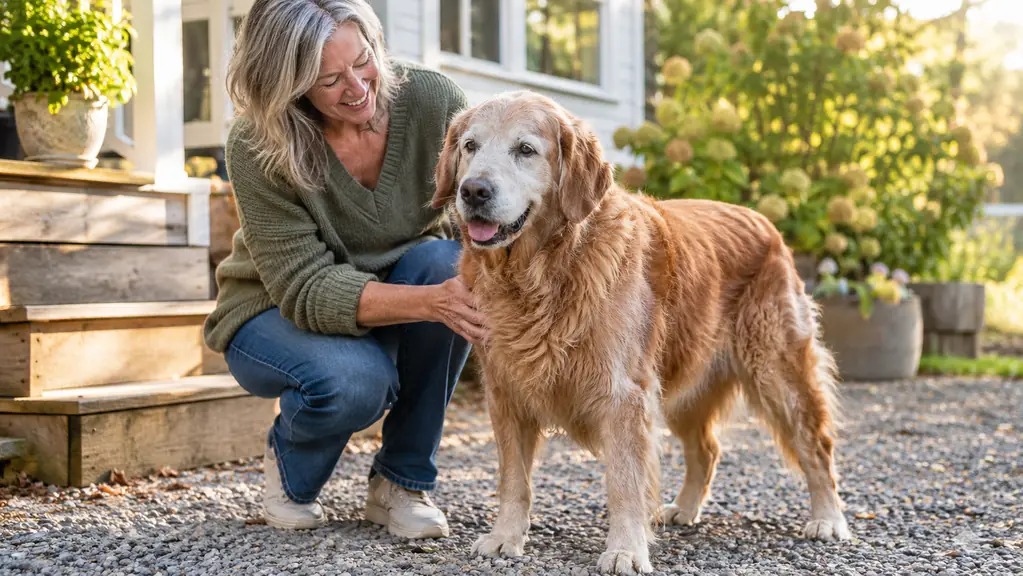
Tansy started stopping at the bottom of the two back porch steps last winter. Not refusing to go out. Just stopping, front paws up on the first board, back end parked on the gravel like it had not gotten the message. She is an 11-year-old spayed German Shorthaired Pointer, about 58 pounds, and she still wants to be in the middle of everything that happens in this house. Our vet said at her senior checkup that her hips and knees are showing age. What that looked like in real life was a dog who needed a count of three and a hand under her back end before she would come back inside.
I tried the obvious things first. A bath towel folded under her belly worked for about four days, until the afternoon she sat down while I was holding it and I nearly went over with her. A wide strap I rigged up myself cut into her more than it helped. The LOOBANI Dog Lift Harness was the third thing I tried, and it is the one that stayed by the back door all spring. Not because it fixed anything. Because it turned a two-person job into a one-person job, and in a widowed house with one dog, that is the whole argument.
The Quick Verdict
A simple, machine washable sling that takes real weight off a dog's back end on steps, car doors and slick floors. It is a helping hand, not a fix, and the sizing runs generous.
Amazon Check Today's Price →The thing that ended the porch-step standoff
One sling, one storage bag, 14.88 ounces. It goes under her back end and takes some of the weight while she does the climbing. That is the entire idea, and it is enough.
Amazon Check Today's Price on Amazon →How I've Used It
We use it two or three times a day, and only for the things she cannot do alone. The two back porch steps, up and down. The step up into the back of the Subaru Outback. The kitchen floor on the days her back feet slide out from under her on the laminate. That is the list. She walks her own route around the yard, she gets up off her bed on her own most mornings, and I do not put the sling on her for any of that. A dog that stops using her legs stops using her legs, and I am not going to hurry that along.
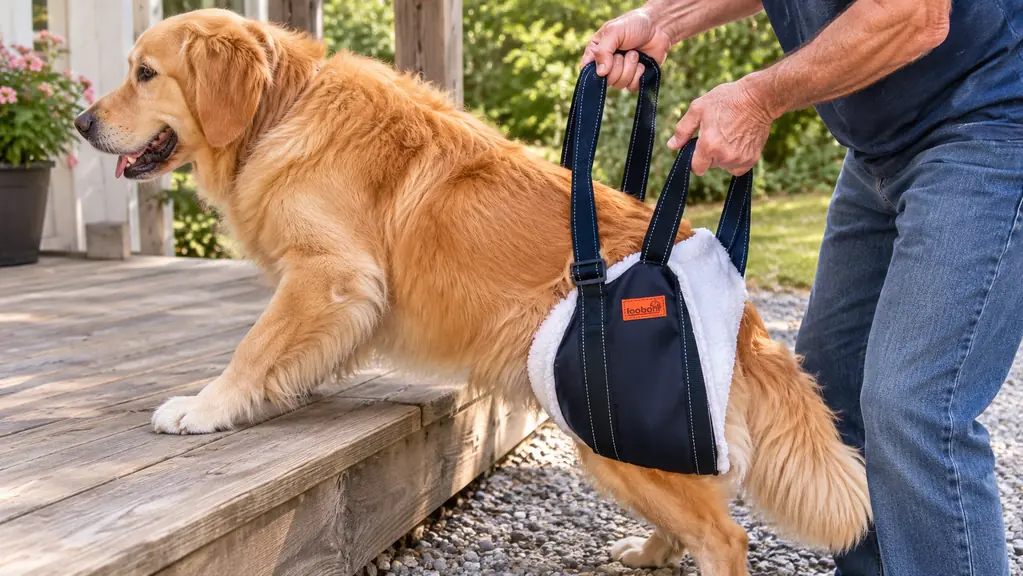
The way it works in practice is unglamorous. I settle the sling under her hindquarters, take the weight in my hand, and let her do the climbing. She still does the pushing. I just take maybe 20 pounds of her off the step so her back end does not have to launch all 58 pounds upward. The first week I over-lifted and she gave me a flat look that meant put me down. The second week I found the feel for it, and now it is about as fussy as holding a leash.
The lining is a soft sheepskin-like fleece, and it is the reason this one stayed. The rigged strap I tried first had a hard edge and left a pink line across her after two days. The LOOBANI sling has enough padding built into it that I do not have to think about it, and I have never once found a raw spot. It goes in the wash with the dog towels on a cold cycle. Five months of that and the lining has not gone flat and the stitching has not let go.
What the Sling Actually Is
Strip away the marketing and it is a plain piece of equipment. A nylon sling with a padded lining, sized extra large for large dogs, that goes under a dog's back end so a person can take some of the weight while the dog moves. It comes with a small storage bag and it weighs 14.88 ounces, light enough that I do not notice it folded in the door pocket of the Outback. There is nothing electronic in it. Nothing to charge. Nothing to adjust wrong at eleven at night with a stiff dog waiting on you.
One thing I checked before I ordered, because I read labels the way some people read novels: it is nylon with a padded lining, and it is machine washable, and that is the whole of it. No gels, no bladders, no parts. For something that is on and off a dog twice a day, that is exactly what I want. It does not need to be more clever than a good strap with padding on it, and I would rather it not try.
That simplicity matters for a dog like Tansy. She is not a dog who will stand still for a harness with four straps and a chest plate. She tolerates this because it takes about four seconds and then we are going somewhere, and because it goes around her back end instead of over her head. If your dog fights equipment, this is an easier sell than a full body harness for the same reason. There is less of it, and it is nowhere near her face.
The size chart is where I would slow down. Extra large is what we have, and Tansy is 58 pounds, which is not a giant dog. It fits her with room to spare. If you have a 40-pound dog, I would read the sizing rather than assume, and if you have a dog over 100 pounds I would ask the company directly before ordering. A sling that is too big slides forward, and a sling that is too small pinches, and either one will make your dog unwilling to stand still for it.
She still does the climbing. I just take about 20 pounds of her off the step. That is the whole job, and it is the whole reason she still goes up.
The Two Back Porch Steps
Here is the honest part. The steps did not get easier for Tansy. She still hesitates. What changed is that she goes up them instead of turning around and lying down in the gravel. For about six weeks in February and March she had decided the porch was not worth the effort, and that meant she was not coming to the door, which meant she was spending more of the day on her bed at the side of the yard. The sling did not make her younger. It made the porch worth the effort again.
What I noticed over months, not days: she started putting herself in position. Around the middle of April she began walking to the bottom step and standing square, waiting, instead of needing to be walked over to it. Same steps, same amount of lifting from me. She just stopped treating it as a fight. I take that as a sign that it stopped hurting the way it had been. I am careful not to claim more than that. My vet is the one who gets to have opinions about her hips. I just report what I see.
There is a limit to what I can tell you and I want to be straight about it. I do not know whether her hips feel better. I know she climbs the steps, she comes to the door, and she is on her feet more of the day than she was in March. Whether that is the sling, the joint supplement she has been on since January, the weight she lost, or the weather finally warming up, I cannot separate out. All four changed at once and I am not going to pretend I ran a trial.
The floor is the other place it earned its keep. Our kitchen is laminate and her back feet slide out from under her when she turns too fast at the water bowl. I cannot put runners down everywhere, and she hates booties. So on the bad days I stand behind her with the sling and let her walk the length of the kitchen with her back end supported. It takes a minute. It has saved me a fall I did not want to be part of, hers or mine.
Getting In and Out of the Outback
The step up into the back of the Subaru was the one I dreaded. She wants to come, and she is too heavy for me to lift clean, which is how I hurt my own shoulder last fall trying. With the sling, she puts her front feet on the bumper and I take her back end and we go up together in one motion. It is not elegant. It works. We have done it for vet visits, for the feed store, and for a drive out toward the reservoir on the weeks she is having a good one.
Coming down is where I am most careful. A dog going down a step or out of a car has to control the descent, and that is exactly what a stiff back end is worst at. The sling lets me lower her rather than letting her drop. If you take one thing from this review, take that. The way up is the part everyone thinks about. The way down is the part that gets dogs hurt.
Where It Falls Short
It is not a hands-free tool. Both of my hands are on the dog when we are on the steps, which means the leash is looped on my wrist and the door is propped with a brick. If you are alone with a dog that lunges at squirrels, do the steps with the door already closed and the leash short. That is less a flaw in the product than a thing nobody tells you about slings in general, and it took me a month to work out a routine that did not involve me hopping on one foot.
I did try a plain rear sling first, the kind that is a wide band and nothing else, and it worked fine for the car and not at all for the steps. It had no padding to speak of and it slid forward every time she climbed. The LOOBANI has more to it, and more is what I needed on a slope. If all you need is help getting a dog into a car on flat ground, a simpler sling would do the job and be less fuss to store.
It also does nothing for the front end. Tansy's front is fine, but if your dog's wrists or shoulders are the problem, a hind end sling is the wrong tool and you would be better off with a full body harness that has a lift point. And it does not replace a vet. It is not a treatment. It does not cure, treat or reverse anything. It is a way to take weight off a dog while she moves, so that moving stays possible.
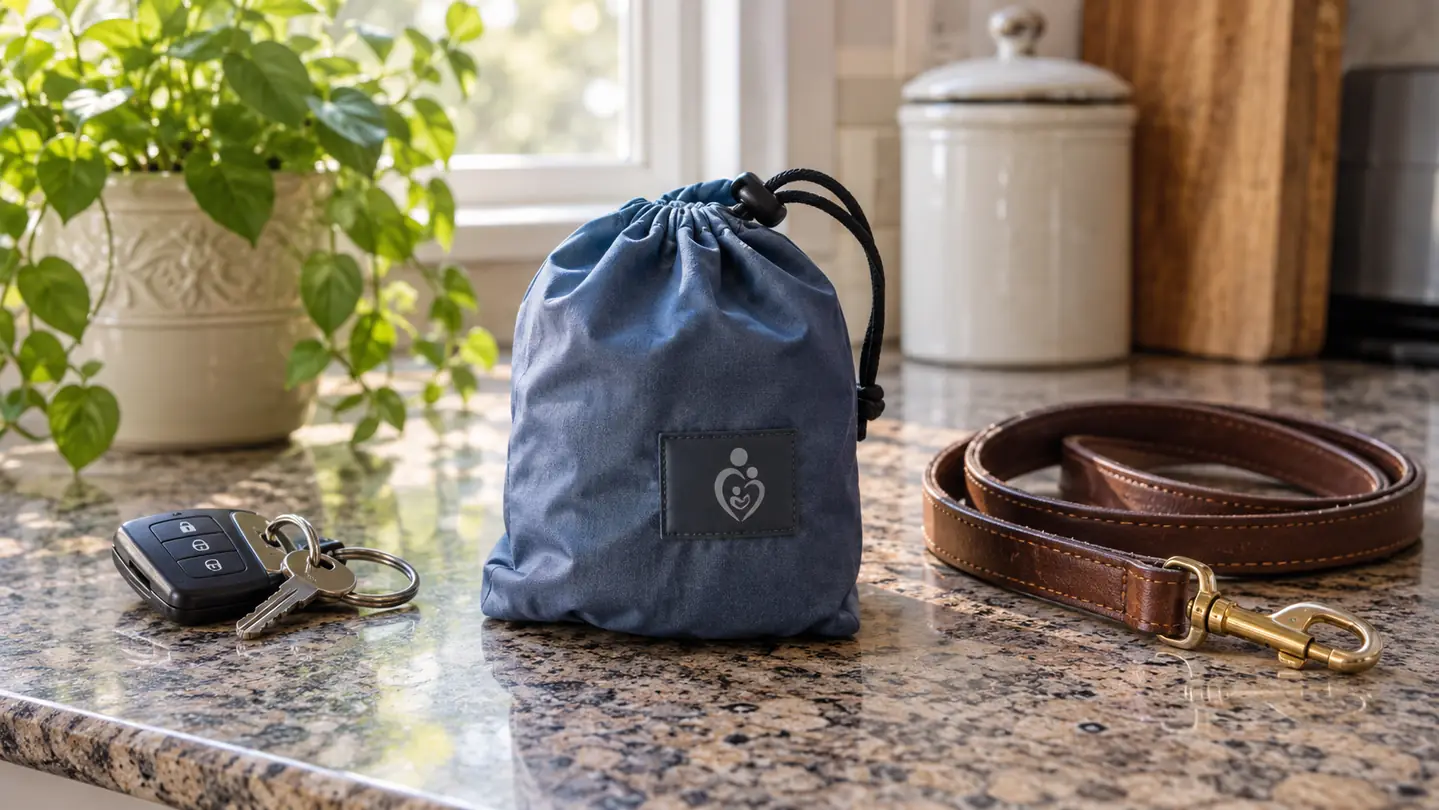
The storage bag is small and I lost it in the first month. That is on me, not on LOOBANI. The sling itself lives folded on the shelf by the back door now, which is where it needs to be, because a mobility aid that lives in a closet does not get used. Also worth saying: it took Tansy about two weeks to stop side-stepping when I reached for it. A dog who has been handled a lot will get there faster than one who has not.
What I Liked
- Takes real weight off a dog's back end on steps, car doors and slick floors
- Padded fleece lining, no raw spots after five months of daily use
- Machine washable, and it survives the wash without going flat
- Light enough to keep by the door at 14.88 ounces
- Sizing runs generous, extra large fits a 58-pound dog with room
- Nothing to charge, adjust or assemble before you use it
Where It Falls Short
- Both hands are occupied whenever it is in use
- Does nothing for front-end weakness, by design
- The storage bag is small and easy to lose
- Your dog has to learn to stand still for it, which took us about two weeks
- Not a substitute for a vet exam or for a diagnosis
Who This Is For
This is for the owner of a dog whose back end has gotten unreliable while the front end still works. The dog who can walk the yard but hesitates at the steps. The dog who slides on hard floors. The dog who needs a hand getting into the car and is too heavy or too proud to be carried. It is also for the person doing the lifting, honestly. I am 63 and I have one good shoulder, and I would rather spend my effort on the walk than on the hoist.
A word about the two of you as a pair. If you are the one doing the lifting and you have a back that has opinions or a shoulder you already hurt once, this is worth more than it looks. I wrecked my own shoulder last fall doing it the wrong way and I am not interested in repeating the experience. The sling puts the load in my hand and my legs instead of my spine, and that has been the difference between walking her twice a day and walking her once.
Who Should Skip It
Skip it if your dog's problem is in the front, if your dog panics when anything touches her back end, or if she is at the point where she cannot bear weight on her hind legs at all. That last one is a conversation with your vet, not a purchase. Skip it too if you are hoping for something that lets a dog get around without you, because this is a two-hands tool and it is going to stay one. And skip it if you are not going to keep it within reach, because the value is entirely in it being there when she stops at the step.
Five months by the back door and it has not moved
The LOOBANI sling is the one piece of equipment in this house that earns its shelf space every single day. If your dog has started stopping at the bottom step, start here and ask your vet the rest.
Amazon Check Today's Price on Amazon →