
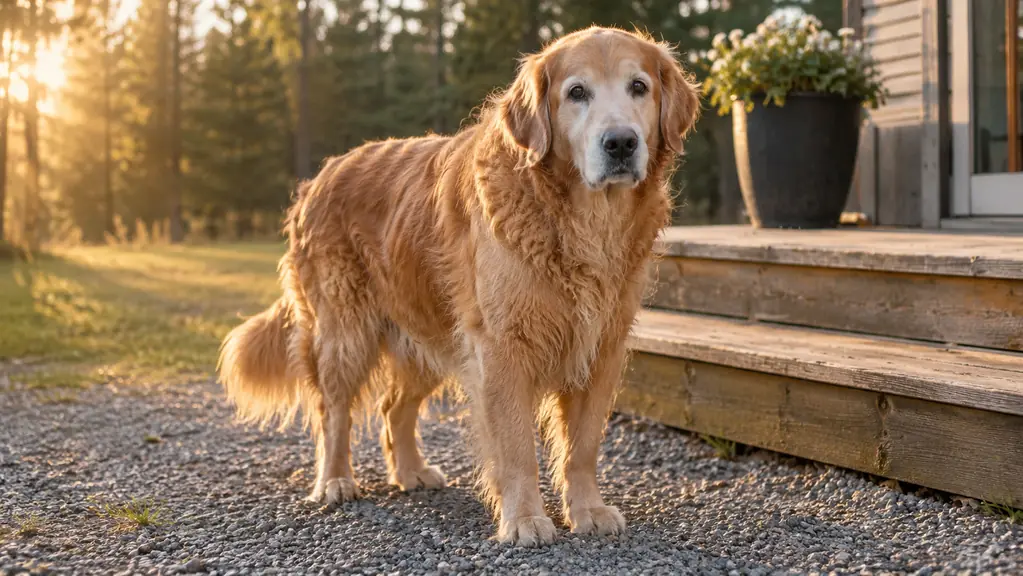
Tansy is eleven. She is a spayed German Shorthaired Pointer, about fifty-eight pounds, liver and white, and she has spent most of her life moving faster than I wanted her to. This spring she started stopping at the bottom of the two back porch steps and just standing there. Not refusing. Waiting. Then she would turn her head and look back at me like I was supposed to know something.
I knew. Our vet told me at her senior checkup that her hips and knees are showing age, and that a good deal of what I was seeing in the yard was her being careful. The step up into the Subaru Outback had started to take her two tries. The kitchen floor had become something she crossed with her toes spread and her back end low to the ground. That is when I bought the LOOBANI dog lift harness for large dogs, and it is the thing that put her back up those porch steps. The steps are what this is about, but the routine below applies to the car, the vet's tile floor, and any other place where her back end has quit on her.
Two porch steps should not be the hardest part of her day
The LOOBANI lift sling puts the weight of her hindquarters into your hands instead of her hips, so she can keep doing the things she has always done. Mine stays folded in the little bag it came with, hanging on the hook by the back door.
Amazon Check Today's Price on Amazon →Before You Start: Two Things to Get Straight
Nothing here replaces your vet. I am a retired rural mail carrier, not a veterinarian and not a vet tech. Thirty years on one mail route taught me to notice how a dog moves, and that is the only expertise I claim. Tansy had a full senior checkup before I started lifting her back end, and I asked straight out whether supporting her was fine or whether I would be doing damage. For her, with her hips and knees, the answer was fine. That answer will not be the same for every dog. A dog with a spinal problem or a dog who has just gone down in the back end needs a vet's hands on her, not mine and not yours.
The second thing is what a sling can and cannot do. It cannot make her stronger and it will not take away arthritis. What it does is lend her a hand, which buys her the ability to keep going up the steps. Keeping going is most of the battle for a dog this age, because a dog who stops climbing steps stops climbing steps fast. But understand that you are the engine of this arrangement. When you are carrying half of her, she is not walking on her own, and there is no point pretending otherwise.
Step 1: Fit the Sling Under the Hips, Not the Belly
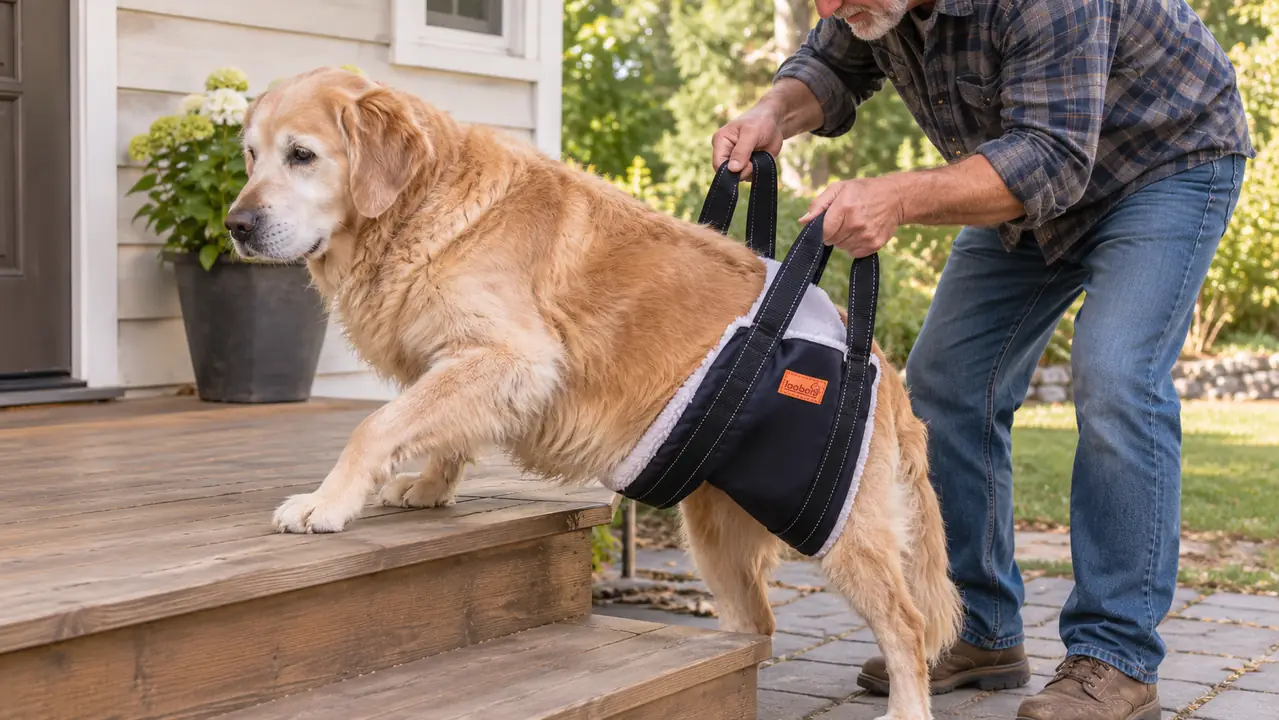
The LOOBANI sling is nylon with a thick, soft lining, and it is built to sit under the hindquarters, just in front of the back legs, not up around the waist. This is the single most important thing to get right. A belly sling is for a dog whose front end is failing. A hind sling is for the dog whose back legs are the problem, which is Tansy. If you put it in the wrong place you will lift her whole middle and she will feel like she is being carried rather than helped.
Placement is a hands-on job and it goes better if you do it on a rug rather than a slick floor. I put it on Tansy while she stood still on the kitchen rug, set the soft lining against her underside at the top of her back legs, and made sure the load fell across my forearm instead of pressing anywhere sharp. You will know it is too far forward the moment you lift, because her front feet will come off the ground.
Mine is the X-Large, which is right for a fifty-eight pound pointer with a deep chest, and it weighs about fourteen ounces, so it is not something she notices hanging there. It folds into the storage bag that comes with it and lives on a hook by the back door, which sounds like a small thing until you are standing in the rain with a stiff dog and need both hands. It also goes into the washing machine, and that matters more than you would think, because this is a piece of fabric that sits against a dog's underside twice a day.
Step 2: Let Her Wear It Standing Still Before You Ask Her to Move
The first time I put it on Tansy she stiffened her back legs and tucked her hindquarters down, which is exactly what a dog does when something unfamiliar is touching her there. If I had clipped it on and immediately headed for the porch, she would have fought me and I would have decided the whole thing did not work. So the first session was thirty seconds, one piece of chicken, and nothing else. On, chicken, off.
Do that three or four times over a couple of days. The sling should predict something good before it ever predicts work. This is the step people skip, and then they wonder why their dog turns into a statue at the bottom of the stairs. A dog who is already sore and already hesitant does not need one more thing in her day that she does not understand.
Then lift once with no steps involved. Stand behind her, take the slack out of the sling, and raise until you feel her weight come off her back feet, hold it for two seconds, and set her down. Watch her ears and her tail rather than her legs. If she panics, you went too fast and there is no prize for hurrying a dog who is eleven years old and already unsure of herself.
Step 3: Take the Porch Steps One at a Time, From Behind
Stand behind her and slightly to one side rather than directly in back, so she is not turning her head around to check on you the whole way up. Take the weight as she shifts forward, let her front feet do the work they can still do, and follow her up. You are not lifting her. You are removing maybe a third of what her hips are being asked to carry, and the difference between all of it and two thirds of it is the difference between a dog who tries and a dog who stands at the bottom and waits.
One step, stop, then the second one. Not both in a rush. Going down is the harder direction for most dogs, and it is where a sling earns its keep, because a dog with weak hind legs going down a step is a dog falling forward. Take more of her weight on the descent than you do on the climb. That was the part I had backwards for the first week.
We did the two back steps twice a day for about three weeks before the hesitation at the bottom went away, and even now she gets the sling on the way down. I do not know whether she still needs it there. I know I would rather carry a little of her than watch her land badly on gravel. The LOOBANI sling is the same piece of equipment in both directions, and it does not care which way she is going.
Step 4: Use It for the Car, the Slick Floor, and the Vet's Waiting Room
The Outback is the other place this matters. She used to launch herself in without a thought. Now the height is a wall, and a dog who fails at a jump once starts refusing it. The sling lets me take her back end while her front legs do the jump, and it has kept her going to the trailhead on the days she is up for it.
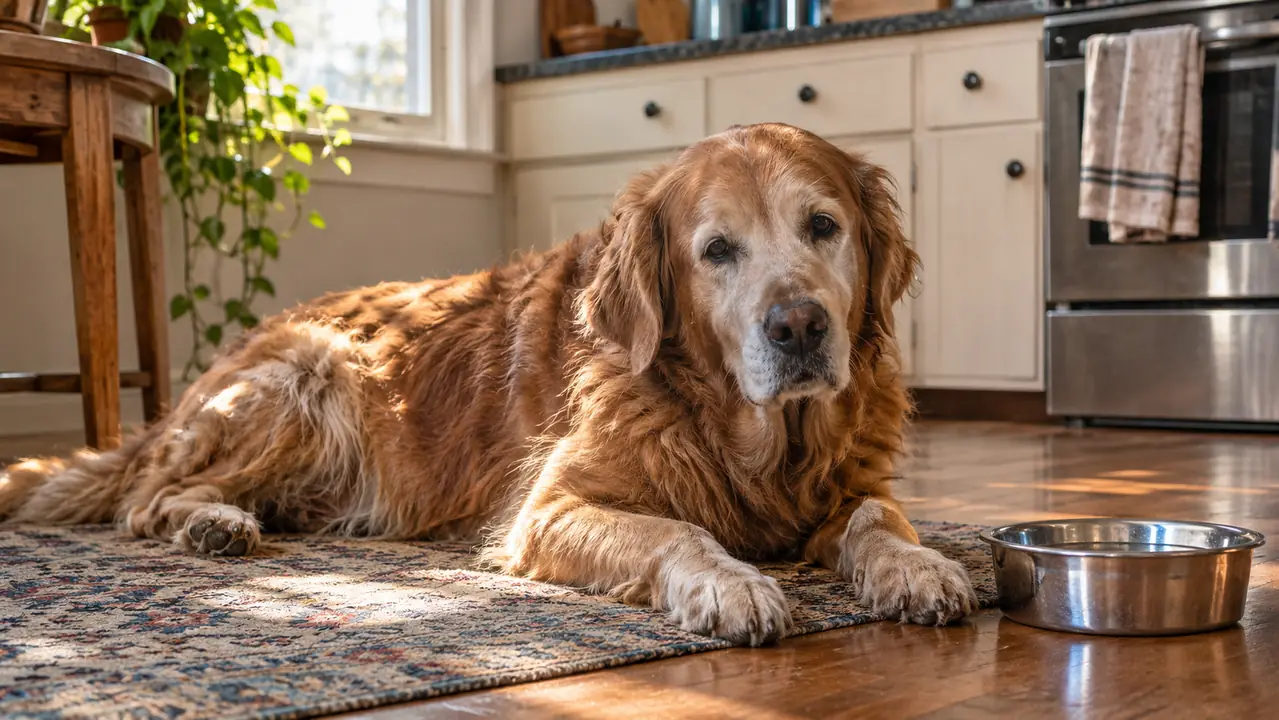
The floors are less obvious and just as important. On the vet's tile, I put the sling on before she comes out of the exam room, because a frightened dog on a slick floor is a dog who is going to scramble. At home it is the kitchen laminate, where her back feet slide out from under her when she turns too fast toward the water bowl. Support through the turn, then let go. You are not carrying her across the room, you are keeping her from doing the splits.
One caution: if your dog is much heavier than sixty pounds, or is a dog who wiggles and fights, this is a two-person job and you should treat it as one. I do it alone with Tansy at fifty-eight pounds and it is manageable. I would not want to try it with a ninety pound dog who does not want to be lifted, and neither should you.
Step 5: Know When to Put It Away
A sling is easy to lean on. I got to the point where I was reaching for it every single time she went out, including the flat trip to the mailbox, and that is not the idea. A dog who can still do a thing on her own should still do it, because using the leg is part of what keeps the leg. The support is there for the hard parts, not for everything.
So I started testing her. Every couple of weeks I would let her take the two back steps without it and watch how she did. Some days she went up clean and I left it on the hook. Some days she stood at the bottom and looked back at me, and I got it out. After about two months, most days she does not need it for the porch anymore. She still gets it for the car and for any floor that shines.
The other half of this step is a conversation with your vet every few months. What you want to know is whether the sling is still a helper or whether it has become the only way your dog gets up. If it is the only way, that is information, not a failure on your part. It means the plan needs to change, and your vet is the one who should be changing it.
Eight weeks in, she took the two back steps without stopping. I noticed because my hand was already out and I did not need it.
What Else Helps
Weight comes first, and it is the least pleasant thing to hear from your vet. Every extra pound on a dog with sore hips is a pound she hauls up those steps twice a day. Beyond that: keep her nails short, because a long nail changes how a dog's foot lands and pushes the whole leg out of line. Put a runner or a cheap rug on the slickest stretch of floor. Cut the long walk into two short ones, since a tired dog gets sloppy in the back end and sloppy is where the slipping happens. If the jump into the car gets to be too much even with help, a ramp is the next piece of equipment to look at.
And the honest part. The sling is one piece of a bigger picture and it does not replace whatever joint support your vet recommends, or the weight management, or the shorter walks, or the checkups. What it does is keep her doing the things that make her still feel like herself. Tansy has spent eleven years running up those two steps and I was not ready for her to be a dog who stays in the yard. I do not know how long this holds. I know it has held since spring, and I know it took me five steps and about a month of being patient to get there.
She still wants to go. This is how you keep going with her.
The LOOBANI lift harness folds into its own bag and hangs by the door. Getting it out takes five seconds. The walk up to the porch takes about thirty. Ask your vet whether hind-end support is right for your dog before you start.
Amazon Check Today's Price on Amazon →