
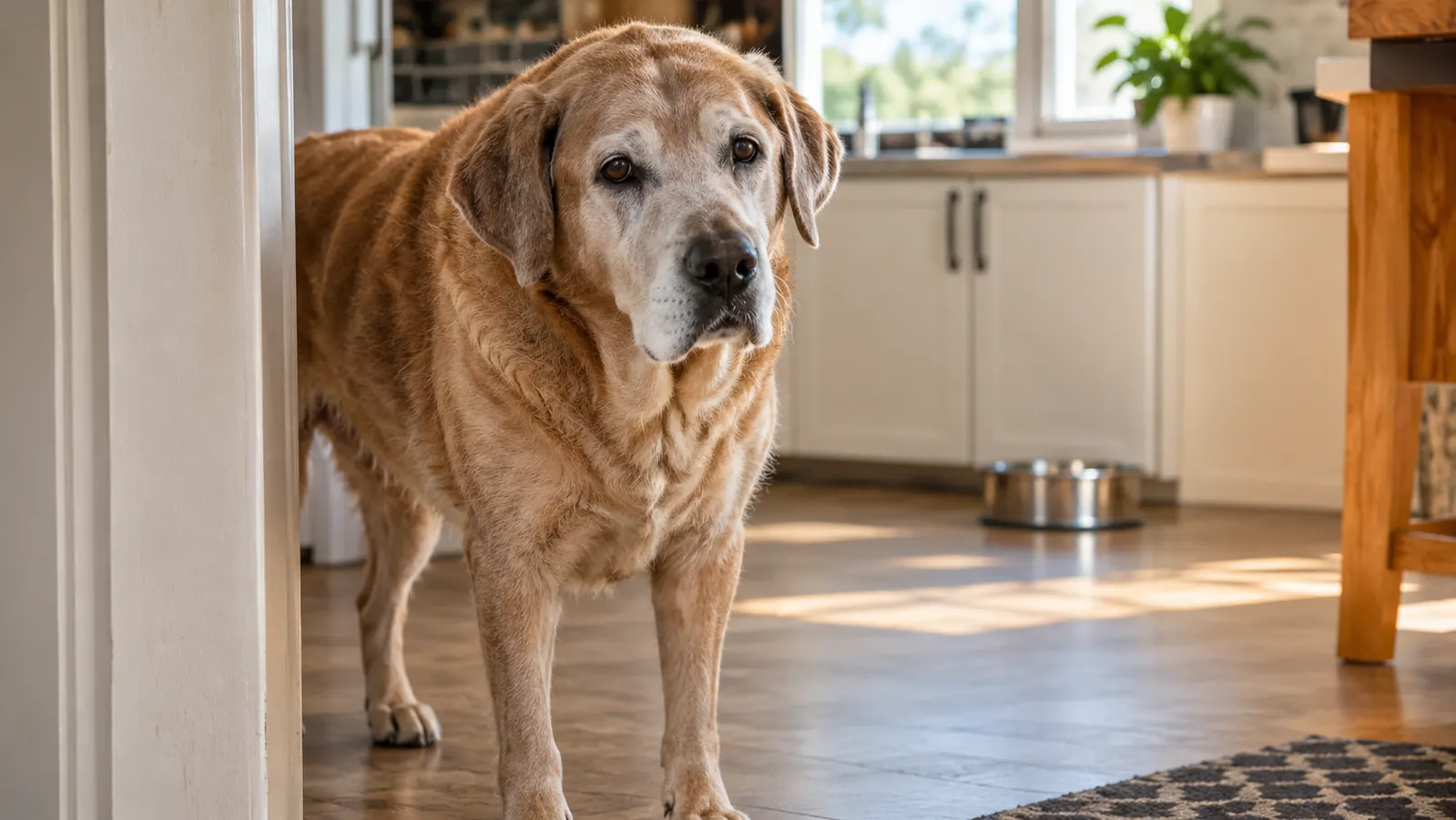
I bought DOK TigerToes dog socks on a Tuesday in February because Tansy had stopped crossing the kitchen. She is an 11-year-old spayed German Shorthaired Pointer, about 58 pounds, liver and white, and for most of her life the kitchen was simply the room between the back door and her bowl. Then the laminate took on that dull shine that comes from years of mopping, and her back feet started to skate. She would stand in the doorway, look at the floor, look at me, and wait. I am 63 and she is 58 pounds, so carrying her in from the yard was not a plan. It was a countdown.
I tried the usual things first. A runner rug from the hall to the sink, which she treated as an obstacle and walked around. Rubber-soled booties she removed in under a minute out in the yard. A paw wax that made the floor greasy and made her worse for two days. Toe grips helped her back feet more than anything else, but Tansy has long pointer toes and the grips needed replacing more often than I had patience for. What I wanted was something she could wear for an hour in the evening that gave her back feet a surface to push against. That is what these socks are for, and roughly what they did, with some caveats worth spelling out before you spend anything.
The Quick Verdict
Real traction on laminate for an older dog, and the grip keeps working after the sock twists, which it will. The learning curve is the strap, not the sock.
Amazon Check Today's Price →She Would Not Cross the Kitchen. Now She Crosses It Without Thinking.
DOK TigerToes come four to a pack with a hook and loop strap on each. Measure the paw across the widest part first, then order.
Amazon Check Today's Price on Amazon →How I've Used It
Start with sizing, because DOK sells these by paw width and not by dog size. Large is listed for paws measuring 2.5 to 2.8 inches, and the pack holds four socks. I measured Tansy's front paw with a strip of paper on the counter, marked it with a pencil, and laid it against a ruler. She came in at 2.6 inches, which puts her in the middle of the Large range. If your dog lands on the line, measure twice. A sock that is too loose will rotate, and while the grip is built to keep working when it rotates, a sock that is too big will slide off the back of the paw entirely.
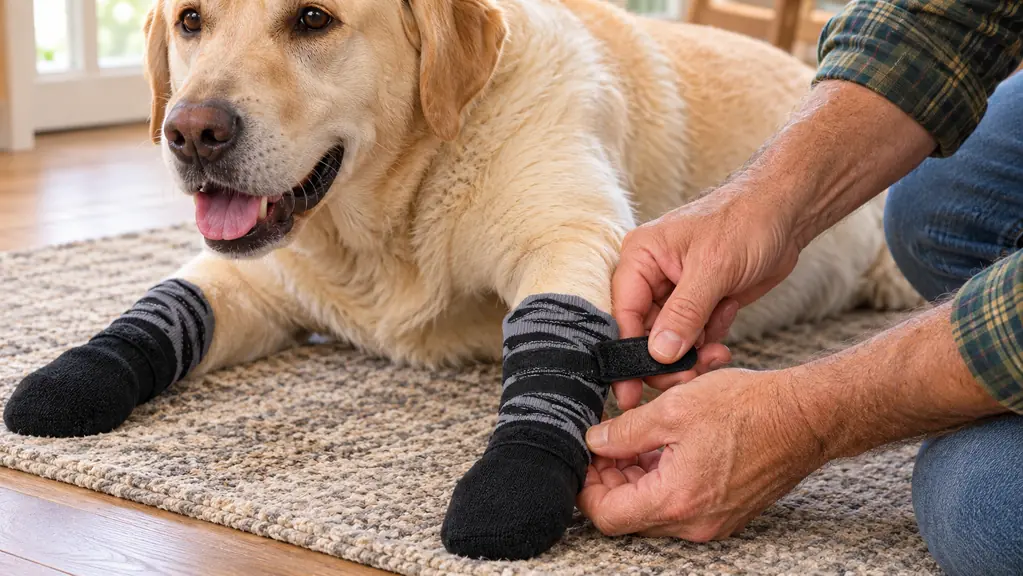
The first night took eleven minutes to get four socks on, and about forty seconds for Tansy to walk out of one. Each sock has a hook and loop strap around the ankle, and I had never used anything like it. My mistake was trying to strap them while she stood. The second night I had her lie down on her bed, put the sock on, set the strap, and gave her a piece of freeze-dried liver. By the fourth night it was a two minute job and she was offering the paw before I asked.
Our routine settled into this. Socks on after her last meal, about an hour and a half of wandering between the kitchen, the hallway, and the living room rug, then socks off before bed. She wears them on the laminate, and once in a while out the back door onto the concrete pad by the steps. I do not send her down the gravel driveway in them. Gravel eats fabric, and I am not made of socks.
I want to be clear about what I am not claiming. These socks do not treat anything. Tansy had a senior checkup and our vet said her hips and knees are showing age, and that is the extent of what I know. The socks give her back feet something to grip so she is not fighting the floor on top of everything else. That is a smaller thing than a cure and a bigger thing than it sounds when you watch a dog refuse to walk into her own kitchen.
What the Grip Actually Does on Laminate
The listing says the grip is built to work even when the sock twists, and I was skeptical, because a pad that rotates off the bottom of the paw is exactly how most socks fail. What DOK appears to have done is wrap the grip material around the sock rather than putting a single pad on the sole. In practice that means when Tansy plants a back foot and the sock turns thirty or forty degrees, there is still grip under the part of the paw carrying weight. I watched for this specifically, because it was the thing I expected to break first, and it held.
The difference on laminate is audible. Before the socks, her back nails clicked and then scraped, that little skid you learn to hear from the next room. With them on, the sound is a dull thump and no scrape. The first time she crossed the kitchen without hesitating at the threshold I stopped what I was doing. It was not a dramatic moment. She just walked to the water bowl like a dog who was not thinking about the floor.
On the concrete pad out back the grip helps less, which makes sense, because concrete is rougher and she is not sliding in the first place. On the living room rug the socks are mostly irrelevant. The laminate is the whole job, and the laminate is where they earn their keep.
Weeks Two Through Six: What Changed and What Didn't
Here is the honest timeline, because week one was not encouraging. Week one: eleven minutes to put on, one sock off within the hour, and a dog who walked stiff-legged and sulked. Week two: down to two minutes to put on, and she started crossing the kitchen on her own to reach the water bowl. Week three: she wore them the full ninety minutes without fussing. Week four: she walked to the back door and stood there waiting for them, which I did not expect.
What did not change is the steps. She still hesitates at the two back porch steps, and the socks did nothing about that, because steps are a strength and balance problem and not a traction problem. I put a rubber mat at the bottom of the steps and that helped the landing more than the socks did. I also started her on a joint supplement around the same time at our vet's suggestion, so I cannot honestly hand all of the improvement to a pair of socks. What I can tell you is that the floor stopped being the reason she stayed in one room.
The other thing that changed is her licking. Tansy had started licking at her back paws in the evenings, which our vet said was likely habit more than anything on the skin. The socks cover the paws, and she cannot get at them while they are on. It is not a fix for the reason she licks. It is ninety minutes a night where the habit does not get reinforced.
Washing, Wear, and the Small Annoyances
They are cotton and nylon and the care instructions say machine wash, so they go in with a load of towels on a warm cycle and come out fine. I let them air dry on the counter, which takes overnight. Six months in, the grip panels have gone slightly fuzzy at the edges and one sock has a thin spot at the heel, but all four are still in service and none of them has lost a strap.
The annoyances are small and consistent. The strap takes two hands, which is fine when your dog is lying down and less fine when she is not. One sock works loose on her right hind foot after about ninety minutes, every time, and I have decided that is a fact about her foot and not a defect. And the socks are not something to leave on all day. They come off before bed and they come off before a walk, because they are traction for indoor floors and not footwear for a mile.
There is also the matter of losing one. Four socks in a pack means a lost sock is annoying rather than a crisis. I keep the spare in the drawer with the dish towels, and I have used it once.

How They Stack Up Against Toe Grips and Booties
Toe grips are still the better answer for a dog who needs traction around the clock, because they stay on the nail and you forget about them. The tradeoff is maintenance. Tansy lost two in the yard in a month and I got tired of the glue. Socks solve the maintenance problem and create a handling problem, because you have to put them on and take them off. If your dog is out of bed and moving all day, grips probably suit you better. If your dog needs help for a couple of hours in the evening, socks are easier to live with.
Booties are a different animal, and I mean that literally. Every pair I tried ended up in the yard. The strap on a sock sits higher and closer to the leg than a bootie cuff, and Tansy tolerated it far better. If you are weighing the two, there is a side by side breakdown of these socks against toe grips on this site that goes deeper into sizing than I can here, and a longer piece on why non-slip socks help older dogs on laminate if you want the general case before you buy a specific pair.
What I Liked
- The grip wraps around the sock, so it keeps contact when the sock rotates on the paw
- Four socks in a pack, so a lost one is an annoyance and not a reorder
- Machine washable cotton and nylon, and they air dry overnight
- The hook and loop strap held on a 58 pound dog who has removed every bootie she has ever worn
- Enough traction that Tansy crossed the kitchen without hesitating by the second week
Where It Falls Short
- The strap is fiddly, and the first three nights took two hands and a piece of liver
- Sizing is narrow and specific, so a paw outside 2.5 to 2.8 inches will not fit Large
- They address the floor and not the joint, and no sock will fix a stiff hip
- One sock works loose on a hind foot after about ninety minutes
- Not for all day wear and not for walks, so they are a routine and not a solution
Week one she wore them for eleven minutes and sulked. Week four she stood at the back door waiting for me to put them on.
Who This Is For
This is for the owner of an older dog who has started avoiding a hard floor. You know the look. The dog stands at the edge of the laminate and thinks about it before every step. The socks are worth trying if your dog's paw measures inside the listed range, 2.5 to 2.8 inches for Large, and if your dog is tolerant enough to leave something on her feet for an hour with a little training. They are also worth trying if your dog has started licking at her paws in the evening, since the socks cover them and interrupt the habit while they are on.
They suit a dog who needs traction for short stretches in the house, not a dog who needs support through a long day. And they suit an owner who will measure a paw with a ruler and a strip of paper instead of guessing, because the fit is the whole thing with a sock.
Who Should Skip It
Skip these if your dog will not tolerate anything on her feet and you are not willing to spend four or five evenings with treats getting her used to it. Some dogs never accept them, and that is not a failure on your part. Skip them if your dog's paw measures outside the listed range. There is no point forcing a sock that rotates off the foot, and a sock that does not fit cannot grip.
Skip them if you are looking for something that addresses the joint itself, because these do not, and no sock will. Traction is a floor problem and joints are a body problem, and you need your vet for the second one. And skip them if your dog is a chewer who goes after whatever is on her feet the moment you leave the room. Cotton and nylon will not survive a determined chewer for an evening.
If Your Dog Is Standing in the Doorway, Start With the Floor
Measure the paw across its widest part, order the size that matches, and give it a week of treats before you decide. Four socks to a pack, machine wash, and a grip that keeps working when the sock turns.
Amazon Check Today's Price on Amazon →