

Tansy is eleven years old, a German Shorthaired Pointer who still thinks every walk is a hunt. What changed is the standing up. She naps on the rug in the front room, and then she takes a beat. Two beats. Then her back end comes up. She stops at the two porch steps and looks at them like they are a math problem. She slides on the kitchen laminate when she turns faster than her feet can keep up. None of that was happening at nine.
If your dog has a version of that list, you are in the right place. When our vet finished Tansy's senior checkup, she said her hips and knees are showing age, and then she said the thing I had already half guessed. A joint supplement was worth trying, and how you start it matters as much as which one you pick. The one that ended up in our kitchen is Cosequin chewable tablets from Nutramax Laboratories. What follows is the order I would do it in if I were starting over, and I would not skip a step of it.
The chewable our vet named before I finished asking
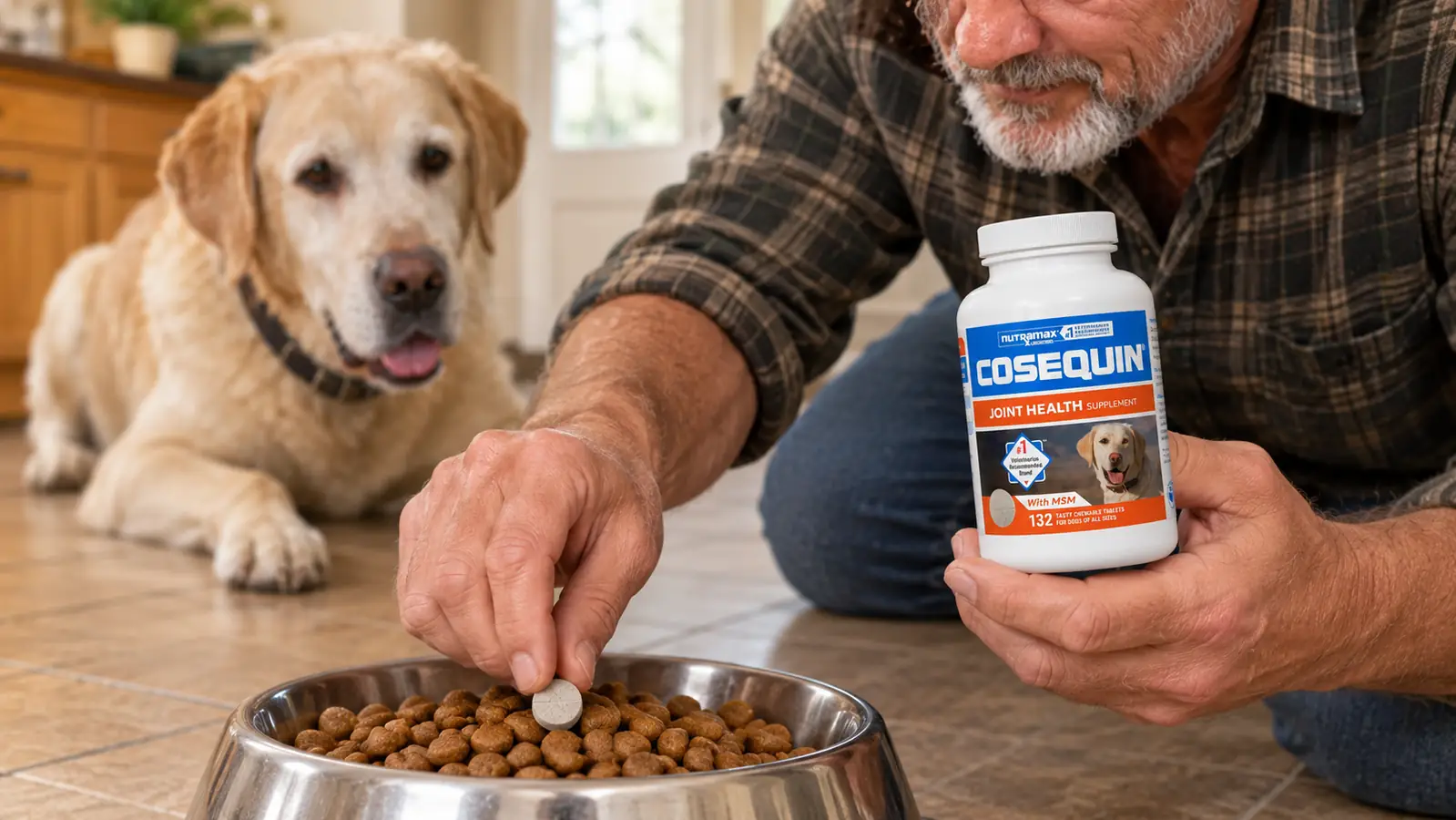
Cosequin chewable tablets from Nutramax Laboratories, 132 count. Read the label, call your vet, then decide. The steps below are the sequence that worked here.
Amazon Check Today's Price on Amazon →Step 1: Get the Vet Check Before You Buy Anything
Stiffness in an older dog can come from a lot of places and not all of them are joints. A torn ligament. A sore back. An infected nail. A thorn in a pad. I spent twenty nine years carrying mail on one rural route and I watched dogs limp for a week over a toenail more than once. A joint supplement will not fix a torn cruciate, and you will burn two months finding that out if you start with the bottle instead of the exam.
Our vet put Tansy through the usual round. Hands on every joint. Watch her walk away and watch her come back. Watch her turn. Watch her get up from a down. She said hips and knees are showing age, and she did not hand me a diagnosis to wave around. I am not going to hand you one either. What she did say is that supporting the joints was reasonable to try, and that we should give it real time before judging it.
Tansy's checkup fell on a Tuesday in October and it ate most of the morning. Our vet is thorough, and a Pointer who has been in the car for twenty minutes wants to smell every corner of the room before she will stand still for anyone. I had written my three things on the back of an envelope in the truck and I read them off out loud. That sounds like a small thing. It is not. Once you say the words porch steps and laminate out loud in a room with a doctor in it, you stop being fuzzy about what you are actually asking for, and you stop hoping a bottle will answer a question only an exam can answer.
Ask your vet two questions while you are standing there. First, is there anything on this exam that a supplement would not help? Second, does anything my dog already takes change what you would pick? Then go home and write down the date, your dog's weight, and the three things that bother you most. That piece of paper is the only way you will know anything later. My three were the porch steps, the step into the car, and the click of her nails on the laminate.
Step 2: Read the Label Before You Read the Reviews
Reviews tell you whether other people's dogs did well. The label tells you what is in the bottle, and that is the part your vet needs to see. Cosequin chewable tablets from Nutramax Laboratories list glucosamine hydrochloride, methylsulfonylmethane, and sodium chondroitin sulfate. Those three names are what you are paying for. Find them on the label and find the amounts next to them.
The detail that trips people up is milligrams per serving against milligrams per tablet. If a serving is more than one tablet, the big number on the front does not mean what you assumed, and you can under dose an older dog for a month without noticing. Divide it out. Work out what one tablet carries, then take that number to your vet and ask what fits a dog of your dog's weight. Tansy runs about fifty eight pounds, and the arithmetic was genuinely different from what I had assumed standing in the aisle.
Then I took the arithmetic back to the clinic. I stood at the kitchen counter with my reading glasses and a pen, copied the three active ingredient names and the per tablet numbers onto the back of that same envelope, and asked the tech to check my figuring. She did it in about ninety seconds and told me I was off by one tablet. Wrong in the safe direction, as it turned out, but wrong. I would rather learn that in a parking lot than in week six, and it cost me nothing but a phone call.
Look at the count while you are at it. The bottle in our cupboard is 132 chewable tablets. Multiply the tablets per day by the days you want to cover and you will know how often you are reordering. I would rather do that math in my kitchen than in the middle of a stiff week. And if your dog has food sensitivities, ask about the ingredient sources before the first tablet, not after the tenth.
Step 3: Set the Amount With Your Vet, and Do Not Freelance
This is not the place for guessing. The bottle has directions on it, and your vet may adjust them for your dog's weight and for what she found on the exam. Follow what the two of them say, written down. More is not better. Doubling the amount because your dog had a rough morning is how a dog ends up off her food and a bottle ends up in the trash.
Ask specifically whether to start at the label amount or ease in. Some dogs do fine from day one and some get loose stools for a week. If that happens, call the vet. Do not decide on your own to push through it and do not decide on your own to quit forever.
We went through the rest of the cupboard that same week, which is worth doing once a year in a house with an old dog. Tansy was on a joint chew from the feed store and a fish oil capsule, and our vet wanted to know about both before she would say anything about the new one. Write down everything, including the chews you think of as treats. Half of what a dog swallows in a day does not look like medicine, and your vet is working from the list you give her.
I put the directions on a sticky note inside the cupboard where the coffee lives, because that is the door I open first every morning. It says the amount and the start date and nothing else. The first week, I still checked it every single time.

Step 4: Same Time, Same Way, Every Single Day
Consistency is most of this job. A joint supplement is not a pain pill and it does not act like one. Think of it as a steady supply of building blocks your dog's body uses, and it needs weeks of that supply before you can judge anything. Miss three days a week and you have not run the experiment. You have just spent money.
Tansy takes hers as a chewable tablet. Some mornings she takes it off the floor like a treat and looks for another. Some mornings it goes on top of her kibble with a splash of warm water and disappears. The bottle sits right next to her food bin so the whole routine is one motion instead of a search through cupboards.
There was a Thursday in November when the routine fell apart. I slept through the alarm, poured her kibble, and left the tablet sitting in the bottle. I did not notice until I was already at the feed store with the tailgate down. That is how a week becomes four tablets instead of seven, and it happens to careful people. The fix was not more willpower. It was moving the bottle off the pantry shelf and into the cupboard where the coffee lives, so the tablet is in my hand before I am properly awake.
Set an alarm if you are the kind of person who forgets, and I am. If more than one person in the house feeds the dog, say out loud who gives the tablet. Two people each giving one because each thought the other forgot is a real thing that happens, and it happens in this house.
Step 5: Write Down What You See, Every Two Weeks
This is the step people skip and it is the step that decides whether you keep going. Memory is a terrible witness. Three weeks in, you will not honestly remember how long she took to stand up on the day you started. So write it down.
I will be straight about the first two weeks of that log. It reads like nothing happened, because nothing did. Week one: slow to rise, stopped at the porch steps, slid on the turn, about a quarter mile before she started lagging. Week two: the same, nearly word for word. If I had been judging on how I felt about the whole thing, I would have quit around day ten and told you it did not work. The paper is what kept me in the chair, because the paper said plainly that I had not run the experiment yet.
Pick four or five things you can actually observe. Ours were these. How long before she gets up from a nap. Whether she stops at the two porch steps. Whether she needs a hand on the step into the Outback. Whether her back feet slide on the laminate when she turns. How far we get before she starts lagging. Same questions every two weeks, same time of day, typed into a note on my phone. Once a month I take a short video of her getting up and walking away from me. Video does not argue with you.
Give it six to eight weeks before you decide anything. Change one thing at a time. If you start a supplement, add a ramp, switch food and buy a new bed in the same week, you will never know which one did the work.
Around week five I noticed I had stopped hearing her nails scramble on the laminate when she turned. That was the whole change, and it took five weeks to show up.
What Else Helps
A supplement works alongside the boring stuff, and the boring stuff is cheap. A long runner or a couple of mats along the path your dog actually takes through the house gives her back feet something to grip. It will not make her young. It does stop the daily scramble that makes a cautious dog more cautious about moving at all. Ours runs from the back door to the water bowl and it changed how Tansy crosses the kitchen.
Nails trimmed short. Weight where the vet wants it. Shorter walks more often instead of one long one. We put a folding step stool by the Outback so Tansy walks up instead of being lifted, because hoisting fifty eight pounds of determined Pointer is bad for my back and worse for her dignity. Warmer bedding than you think an old dog needs in a Bend winter. And when the vet says recheck in six months, put it on the calendar in pen.
One honest note before you close this tab. None of this treats or reverses anything. It supports joints, and that is a smaller claim than the packaging around this whole category would like you to believe. If your dog's comfort is getting worse instead of better, that is a vet conversation, not a reason to buy a bigger bottle.
Give it eight weeks, then judge it honestly
Cosequin chewable tablets from Nutramax Laboratories, 132 count, with the label amounts your vet needs to see. Start the note on your phone the same day you start the bottle.
Amazon Check Today's Price on Amazon →