

The first time I saw it plainly was in my own kitchen. Tansy got up from her bed, took two steps toward the water bowl, and both back feet slid out from under her on the laminate. She caught herself. She looked embarrassed, which I know is me putting a feeling on a dog, but that is what it looked like. She is eleven now, a German Shorthaired Pointer, about 58 pounds, and up to that morning I had been telling myself the floor was just slick.
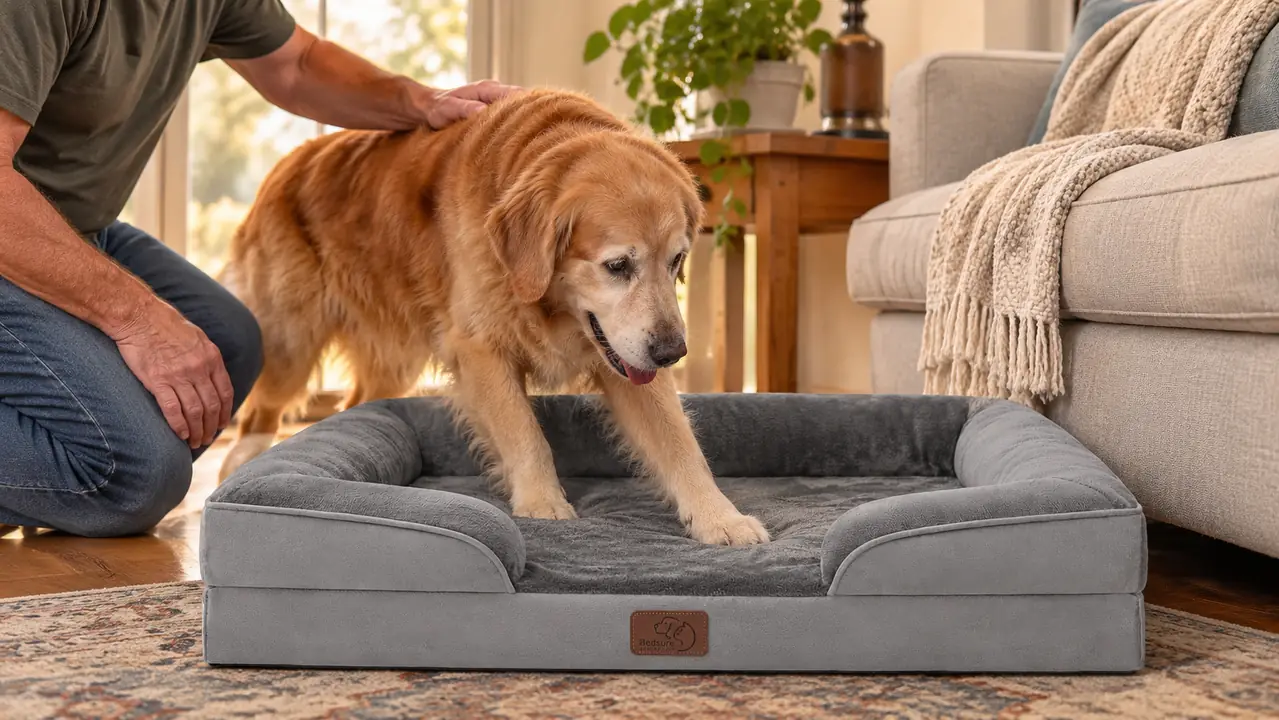
What I learned over the next few months is that a bed for a stiff dog is not the same thing as a nice bed. I bought two before I got it right. The first was too soft, and she sank into it and had to rock herself forward three times to get out. The second was firm but too short, so she hung off the end and pushed with her front legs to stand. The one she uses now is a Bedsure orthopedic bed, the sofa style with a bolster on all four sides, and the reason it works has less to do with the brand name than with about five measurements I wish somebody had told me to take first.
What finally got Tansy off the floor without the three rock start
A 35 by 25 inch orthopedic bed with bolsters on all four sides, a cover that unzips and washes, and foam that stayed dry through two overnight accidents. Measure your dog lying flat before you order, the way I should have the first time.
Amazon Check Today's Price on Amazon →Why the Wrong Bed Makes the Problem Worse
A dog with sore hips has a small number of ways to be comfortable and a large number of ways to be uncomfortable. Lying on a hard floor puts direct pressure on the point of the hip and the elbow, and the skin over those spots is thin. Lying on a bed that is too soft means sinking until the floor stops her, which is the same as lying on the floor with extra steps. Lying on a bed that is too short means she hangs off the side and sleeps with her spine in a curve, and then has to untangle herself in the morning.
The other half of it is the getting up. Standing from a lying position is a rear leg exercise for a dog, and it is the one a stiff dog is worst at. Anything that makes that harder, whether it is a hole in a soft cushion, a slippery cover, or a bed that skids across the floor when she pushes off, adds a small insult to an already sore joint several times a day. That is the part I did not appreciate at first. It is not one bad night. It is twenty small wince inducing moments a day, and they add up.
So the standard I ended up using was not which bed looked the most comfortable. It was which bed made standing up easier. That is a different question with a different answer, and it is why I ended up with a firm, low, four sided Bedsure bed instead of the deep pillow I would have picked for myself.
Five Things to Check Before You Buy
Step 1: Measure Her Lying Down, Not Standing
Measure from the base of the tail to the front of the chest while she is flat out, and then measure across her widest point with a couple of inches to spare. Tansy came out around 30 inches long and 22 inches across when she was properly sprawled, which put her past every medium bed I had looked at. A bed that is too short is easy to spot once you know what you are looking at. She piles her back legs against the bolster, and when she stands up she is pushing off a folded leg instead of a flat one.
Then measure the floor you actually have. I put a tape down where her old bed sat and found 40 inches between the wall and the closet door. The large Bedsure measures 35 by 25 inches and stands 7 inches tall, so it fit with room for me to walk past. That mattered more than I expected. A bed you have to step over is a bed that gets shoved out of the way, and a bed that gets shoved ends up in the garage.
The listing runs nine sizes from 20 inches up to 52. If your dog lands between two sizes, take the bigger one. On a bed that is a shade too small, a stiff dog spends the night half on and half off, and that is the exact posture you are trying to get her out of.
Step 2: Watch How She Gets Down and How She Gets Up
Spend one evening actually watching instead of half watching. Note the shape she makes. Tansy sprawls out flat when the house is warm and curls tight when it is cold, and either way she likes something against her back. A dog that curls wants a bolster or a corner to push into. A dog that sprawls wants a wide, flat center with nothing forcing her spine into a curve. A four sided bolster like the one on this bed suits both, because there is an open middle and a wall to lean on.
Then watch the getting up. If she rocks forward two or three times before her back end comes off the floor, she is borrowing momentum because her hindquarters are not doing the work they used to. That rocking is the motion the bed has to help with. Foam that is too soft swallows her and makes the rock worse, because she has to climb out of a hole. Foam that pushes back gives her something to push against, and that is the whole trick.
Write down what you see, too. Not because a list is magic, but because in three months you will not remember whether she was rocking twice or four times, and a note is the only way to know whether anything you changed actually did anything.
Step 3: Match the Fill to the Body, Not to the Word Orthopedic
Orthopedic is a word on a lot of boxes and it does not mean much on its own. What you are after is pressure distribution. When Tansy lies down, her elbows and her hips are carrying 58 pounds against whatever is underneath. On a thin bed those two spots get no relief at all. Her bed is filled with polyurethane foam, the egg crate kind that comes with the cover and the bolster, and the test I did in the store aisle I did again at home. Flat palm on the center of the cushion, press down hard, and see what is under your hand. I can still feel foam. I do not feel floor.
I want to be plain about what a bed is and is not. It does not treat arthritis. It does not reverse anything, and anybody who tells you otherwise is selling you something. What it can do is take some of the daily wear out of lying on a hard floor and give a stiff dog a surface she can get off of. Our vet put it to me this way. Comfort and traction are the two things you can control at home, and the rest is a conversation to have with your vet before you change anything.
Flat palm on the center of the cushion, press down hard. I can still feel foam. I do not feel floor.
Step 4: Check the Cover Before You Check Anything Else
Old dogs leak. There is no delicate way to put it. Tansy has had two accidents this past year, both on cold nights, and both times I was glad the cover came off and the foam under it was waterproof. A bed with a cover that will not come off, or foam that soaks straight through, is a bed you throw out inside a year. The Bedsure cover unzips, goes in the wash, and the foam wiped down with a damp cloth and dried overnight both times.
Look at the zipper and the seams first. A cheap zip on a bed that gets washed every couple of weeks is the first thing to fail. Then check whether the bolster is part of the same cover or a separate insert, because a bolster that comes loose in the machine comes out as a lump you have to wrestle back into the corners while the dog watches you do it.
One more thing on washing. Run the cover through the machine before it ever goes on the floor. New beds carry a smell from the factory and from the bag, and a dog with a good nose notices things we do not. It costs nothing but an afternoon and it removes one reason for her to refuse the thing.
Step 5: Put It Where She Already Sleeps, Then Leave It Alone for Two Weeks
Do not put the new bed where you think it ought to go. Put it where she already lies down. In my house that was the strip of floor beside the woodstove, about four feet from where the old bed had been sitting. I moved the Bedsure there and she was on it that same night.
Then leave it alone. The first three nights Tansy circled it, looked at me, and slept on the bare floor next to it. On the fourth night she got in. By the end of the second week she was walking to it on her own after the evening loop, which for a dog that had started hesitating at the two back porch steps was a thing worth sitting down and watching. If after two weeks she still will not use it, the problem is usually the height or the firmness and not the dog being stubborn. A bed that stands 7 inches tall is a step up for a dog with sore hips, so a flatter bed on the floor is worth trying before you give up on the idea entirely.
What Else Helps
A bed is one piece of a bigger picture and I would be lying if I said it was the piece that fixed everything. The single biggest change in this house was a rug. I put a cheap runner down the length of the kitchen and Tansy stopped splaying on the turns. If your dog is slipping on hard flooring, that is the fastest thing you can do, and it works on the same day you do it.
The second thing was the car. She had started stopping at the back of the Subaru and looking at me instead of jumping in. I got a folding ramp and now she walks up it, and while the hesitation at the porch steps is still there, the car is not a fight anymore. Ask your vet whether a ramp suits your dog's specific hips and knees. Mine said yes, with the caveat that Tansy should still be doing the walking she can do.
Keep her nails short, too. I let Tansy's go longer than I should have over one busy winter, and the difference in her grip on the laminate after they were trimmed was not subtle. Long nails push the paw up and back and lift the pads off the floor. It is a five minute job and it does more for grip than most of what you can buy.
And the third thing takes longer than any of it. Tansy is a little lighter than she was a year ago, on our vet's advice, and that has done as much for her getting up as anything I have bought. Every pound off a sore hip is a pound she is not lifting every time she stands. If your dog is carrying extra weight, have that conversation before you spend anything on a bed.
The one she actually gets up from
Four bolsters, a cover that unzips and washes, waterproof foam, and a 35 by 25 inch footprint that fit between the wall and the closet door. Measure your dog flat out first, then order the size that leaves a couple of inches to spare.
Amazon Check Today's Price on Amazon →