
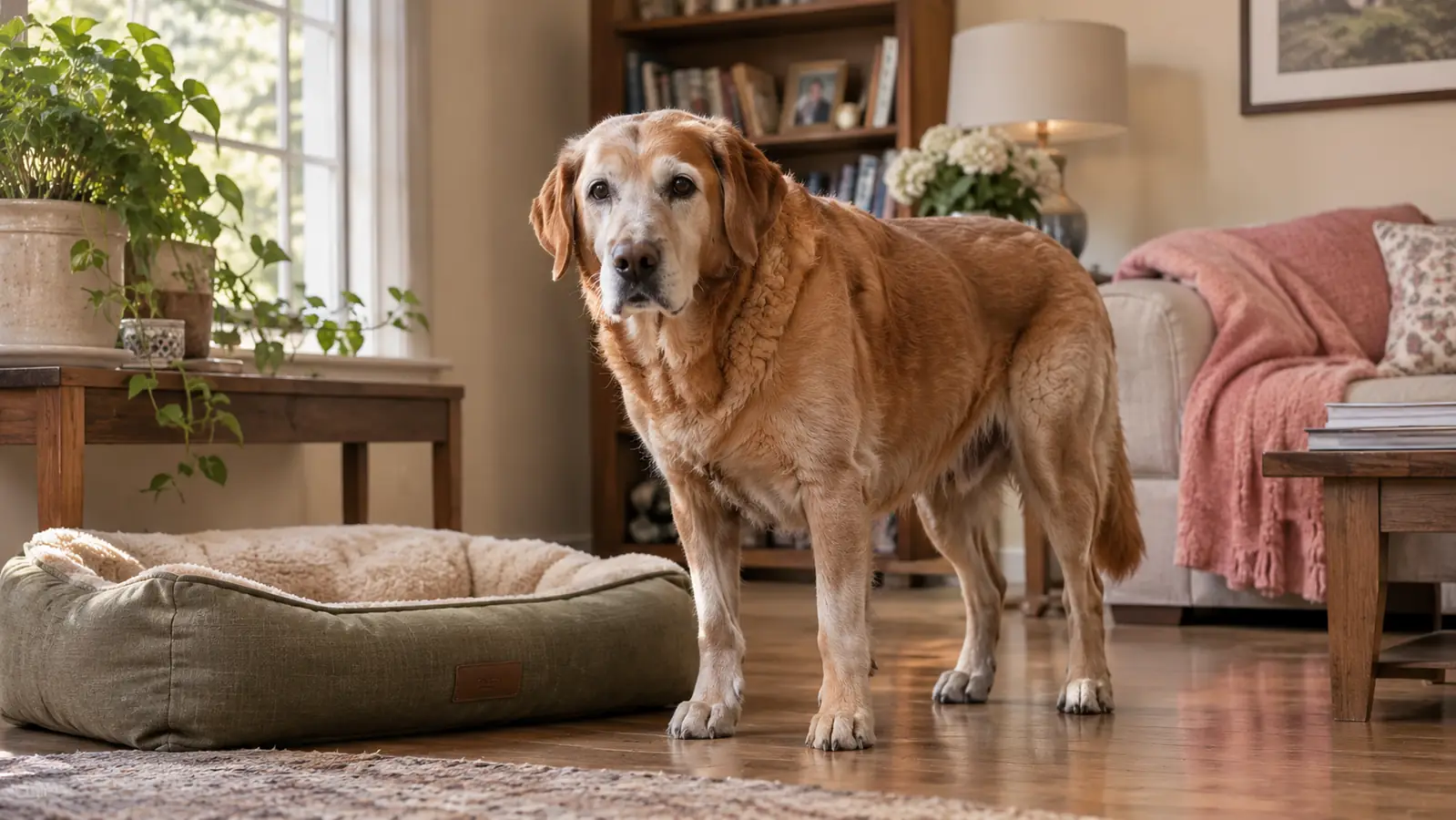
The first thing I noticed about the Bedsure orthopedic dog bed was not the bed itself. It was that Tansy walked past it for three days. She is eleven, a German Shorthaired Pointer, about fifty-eight pounds, and she has opinions. A new object on the living room floor is guilty until proven innocent. So the bed sat in the corner with its bolster and its egg-crate foam while she slept on the bare laminate two feet away, which is exactly the floor I was trying to get her off. If you are reading this because your own older dog has started slipping on hard floors, or takes a long time to stand up after a nap, I want to be straight with you from the start. This is a comfortable bed. Comfortable is not the same thing as a fix.
I am Lorraine Ardmore. I carried mail on the same rural route outside Bend, Oregon for twenty-nine years, and I am not a veterinarian, not a vet tech, and not qualified to tell you anything about your dog's diagnosis. What I can tell you is what I watched for six weeks in my own house with my own dog, and what I would want a neighbor to tell me before spending money. Tansy has had her senior checkup. Our vet said her hips and knees are showing age and left it at that. Everything here is about comfort and support, not about treating anything. That distinction matters more than any star rating, and this Bedsure bed is a good example of why.
The Quick Verdict
A genuinely comfortable, washable bolster bed that gave Tansy a softer place to land. It did not change how she walks, the weight field in the size chart is misleading, and the foam is not a medical device. Worth it for comfort. Not worth it if you expect a different dog in a week.
Amazon Check Today's Price →If Your Dog Is Slow to Stand Up, Start With a Softer Landing Spot
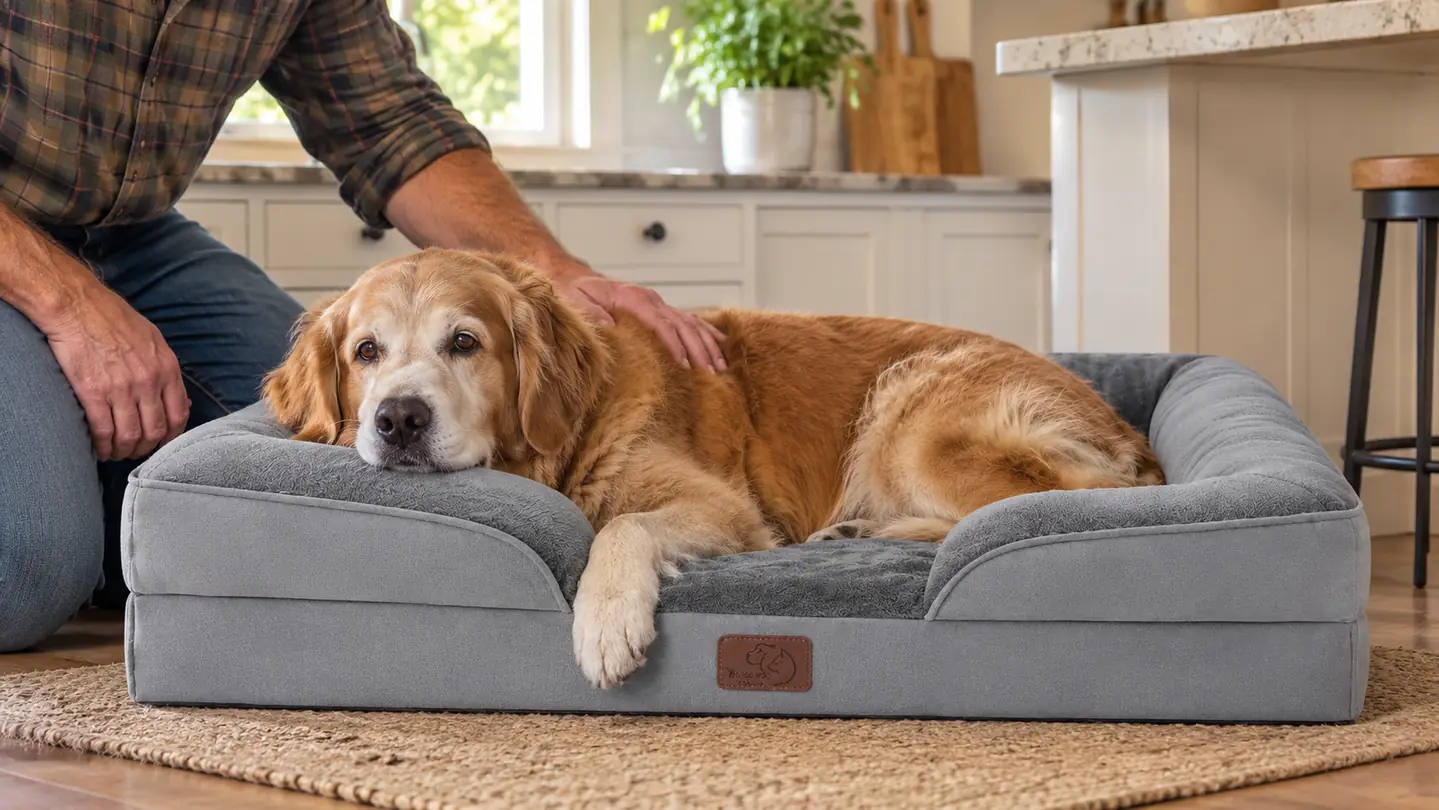
This is the bed Tansy actually uses now. Measure your dog nose to base of tail before you pick a size, and ignore the weight field in the product details.
Amazon Check Today's Price on Amazon →How I've Used It
The bed came out of the box in three pieces: the cover, the bolster that runs around all four sides, and the egg-crate foam pad that is the orthopedic part. It weighs a little over five pounds and measures 35 by 25 inches with a listed height of 7 inches, so it does not swallow a whole corner of the room the way some large beds do. I put it in the living room first, next to the sofa where Tansy likes to keep an eye on the front window, because that is where she does most of her napping and where the floor is hardest.
For the first three days she ignored it. On the fourth she stepped onto it, circled twice, and got off. On the fifth she lay down with her front half on and her back end hanging off, which is her usual compromise. It took about a week before she would stretch out on it, and about two weeks before she chose it over the floor when the floor was an option. I did not do anything clever to speed that up. I put a worn shirt of mine on it for two nights, and I stopped dragging it from room to room.
Before this I had a flat standard dog bed with a thin polyfill pad, and before that a folded quilt. The quilt was free, Tansy liked it, and it did nothing about the way her back feet slid when she stepped off it onto the kitchen floor. I am not going to pretend the Bedsure bed fixed that either. It is a better landing spot and nothing more, and I would rather tell you that than sell you a story about my dog getting younger.
The Size Chart Is Where Most People Get Confused
Here is the first thing nobody tells you. The weight number in the product details is not the number to shop by. The size I have carries a maximum weight recommendation of 30 pounds, and Tansy is 58. If I had read that field alone I would have ordered something bigger or walked away. Then the listing bullets say the nine sizes run from 20 inches to 52 inches and fit puppies up to giant breeds at 150 pounds, which is a different story entirely. Both numbers sit on the same page and they do not agree.
What worked for me was ignoring both and measuring the dog. Nose to the base of the tail, and then the width across her front legs when she is lying in her usual curl. Tansy measures about 30 inches nose to tail base, so the 35 inch bed leaves her roughly five inches of room, which is right for a dog who curls and tight for a dog who sprawls. If your dog stretches out flat with her back legs out behind her, size up. A bed that is too small is worse than the floor, because the dog spends the night holding herself on the edge.
The other size note is about the foam. The egg-crate pad is the same style across the range, but the experience of it under a 15 pound dog and under a 90 pound dog is not the same. The listing says every size gets the same premium comfort, and I think that is the intent, but a heavy dog sinks deeper than a light one. Tansy at 58 pounds sinks enough that I can see the shape of her hip when she gets up. She has not bottomed out onto the floor six weeks in, but I would not expect this foam to hold a much heavier dog off a hard floor for years.
What the Egg-Crate Foam Does, and What It Doesn't
The foam is polyurethane formed into an egg-crate pattern, and the point of the pattern is that the raised sections compress independently, so a hip bone or an elbow presses into a soft spot instead of a flat sheet. That is a real difference from a polyfill pad. When Tansy lies on her side, her hip settles into it rather than resting on top of it. I noticed it in the first week because she stopped shifting every few minutes the way she did on the flat bed.
What it does not do is change how she walks. I want to be plain about that, because the words orthopedic and joint get used loosely. A foam bed is a comfort product. It supports a body that is lying down. It does not treat arthritis, it does not reduce inflammation, it does not strengthen anything, and it will not make a stiff dog less stiff on a cold morning. Our vet was clear with me that bedding is one piece of a bigger picture, along with weight, exercise, traction on hard floors, and whatever your vet recommends for your dog specifically. Ask your vet first. Do not buy a bed instead of making that call.
Where the bed did earn its place is sleep. Tansy sleeps longer stretches on it than she did on the floor, and a dog who sleeps better is easier to live with and probably feels better. That is not a medical outcome. It is a real one. She is less cranky in the morning, and I will take that.
The Bolster Took a Week to Earn Its Keep
The bed is built sofa style with a bolster around all four sides, and Bedsure describes itself as the original maker of that shape. Whether that is literally true I cannot verify and it does not matter much to me. What matters is what a bolster does for an older dog. Tansy rests her chin on it. She also uses it as something to push against when she stands up, which I did not expect and which is the best thing about this bed for her.
The tradeoff is that four sides make a step. The bed's listed height is 7 inches, and most of that is the bolster wall. For a young dog that is nothing. For an 11 year old Pointer with stiff hips, stepping into a walled bed is a decision. That is exactly why she walked past it for three days. If your dog is very weak in the back end, or very small, look at a bed with a low or open front, or a bolster that runs along one or two sides only. This shape suits a dog who can still step and frustrates a dog who cannot.
Washing It, and the One Thing the Listing Buries
The cover is removable and the listing calls it waterproof, and the materials are polyester over polyurethane foam. That combination is why this bed is practical in a house with an old dog. Tansy has had two accidents on it in six weeks, both on damp cold mornings, and both times I took the cover off, wiped the foam down, and had the bed back together the same day.
Here is the part that gets buried: the foam insert should not go in the washing machine. The listing makes the point in a roundabout way by asking whether you hate beds where the main cushion insert gets soaked and clumps in the wash. Egg-crate foam will do exactly that. So the cover goes in the machine and the foam gets spot cleaned and air dried, and if you skip that distinction you will be shopping for a replacement in a month. The cover has been through four washes without pilling or shrinking, and it went back on without a fight, which is not always true of covers built around a foam pad.

Six Weeks In: The Honest Scorecard
She uses it every day now, usually for her afternoon nap and again in the evening. She still sleeps on the floor by the back door at night, which is her choice and has nothing to do with the bed. Her stiffness is unchanged. She is still slow to stand after a long nap and she still hesitates at the two back porch steps and the step up into the Outback. I did not expect otherwise and neither should you. What changed is smaller and more concrete. She gets up off the bed faster than she got up off the floor, and she no longer has red pressure marks on her elbows.
The things I would change, if anyone asked. The 30 pound weight field on the size I have is misleading and made me second guess my order. The bolster is high enough that a weak dog has to commit to getting in. The foam is not dense enough that I would trust it under a very heavy dog for years. And the bed is indoor only, which is fine, but it means it is not the thing you put in the garage or the back of the Outback on a cold morning at the trailhead. For those, a flat pad and a rug are still easier.
What 36,000 Ratings Do and Don't Tell You
The listing shows 4.5 stars across more than 36,000 ratings, and the bullets mention 32 awards, magazine features and television. I understand why that reassures people and I want to be fair to it. A bed that thousands of households have bought and mostly liked is probably a decent bed. That is the useful part of the number.
The useless part is that a star rating averages out every dog into one number. A person with a two year old Labrador who sleeps eleven hours a day is rating a different experience than I am. No star rating can tell you whether the bolster is too tall for your dog or whether the foam is dense enough for her weight. Read the reviews that mention the size and the age of the dog, and ignore the rest. Then measure your own animal. That is the only research that has ever helped me.
What I Liked
- Egg-crate foam gives real relief under hips and elbows, noticeably softer than a thin polyfill pad
- Four sided bolster gives an older dog something to brace against when standing up
- Removable, waterproof cover handled two accidents without ruining the bed
- Just over five pounds, so it moves from room to room without a fuss
- Rectangular footprint fits beside a sofa instead of taking over the floor
Where It Falls Short
- Weight field says 30 pounds while the bullets talk about dogs up to 150, so measure the dog instead
- 7 inch bolster wall is a genuine step for a weak or small dog
- Foam insert cannot go in the washer, only the cover can
- Not dense enough that I would trust it under a very heavy dog for years
- Built for indoor use, so it is not a car or garage bed
Her stiffness is unchanged after six weeks. What changed is that she gets up off the bed faster than she got up off the floor, and she stopped shifting every few minutes trying to find a soft spot.
Who This Is For
This bed suits a dog in the middle of the senior years who can still step over a low wall and who has started looking for a soft spot instead of dropping onto the floor. Tansy is 58 pounds, 11 years old, and it fits her. It also suits the owner who needs something washable, because an older dog will have accidents and a bed you cannot clean is a bed you throw away. If your dog is somewhere between 30 and 70 pounds, still mobile, and stiff after rest, this is a reasonable first orthopedic style bed to try. Measure before you order and you will save yourself a return.
Who Should Skip It
Skip it if your dog cannot step over a wall, if your dog is very small, or if your dog is at the heavy end of the range and you need something that will not compress under her. Skip it if you want a bed for the car, the garage, or a cold truck bed, because this one is built for indoor use. And skip it if you are hoping a bed will replace a conversation with your vet about a dog who is genuinely struggling. A bed is a comfort purchase. For Tansy it was worth it. For a dog with a different set of problems, a flat pad and a rug runner on the kitchen floor may do more good.
A Softer Landing Spot Is a Small Thing. It Is Still Worth Doing.
Tansy uses hers every afternoon now. Measure your dog nose to base of tail before you pick a size, ignore the weight field, and ask your vet about the stiffness first.
Amazon Check Today's Price on Amazon →